How Much Power Do You Actually Need in a Van or RV?

DisclosureThis page contains affiliate links. If you buy through them, we may earn a commission at no extra cost to you.
Almost every question about van and RV power gets asked in the wrong unit. How many days will this last? Is 1,000 watts enough? Do I need two batteries or three? None of those are answerable, because none of them describe what you’re running.
There is one number that makes the whole problem tractable, and it takes about ten minutes to work out for your own trip. Once you have it, the shopping decision answers itself and you stop guessing.
The only math you need
Watts × hours = watt-hours. That’s it.
Watts (W) is the rate something draws power right now. Watt-hours (Wh) is how much energy it consumes over time. A 40 W fan running for 8 hours uses 320 Wh. Batteries and power stations are sold in watt-hours, so if you can add up your loads in watt-hours, you can compare them directly against the thing you’re thinking about buying.
If a spec sheet gives you amps instead of watts, multiply by the voltage: 5 amps at 12 volts is 60 watts. Most 12-volt RV appliances are labelled in amps, so you’ll do this conversion a few times.
Two corrections apply to the raw math, and both push in the same direction:
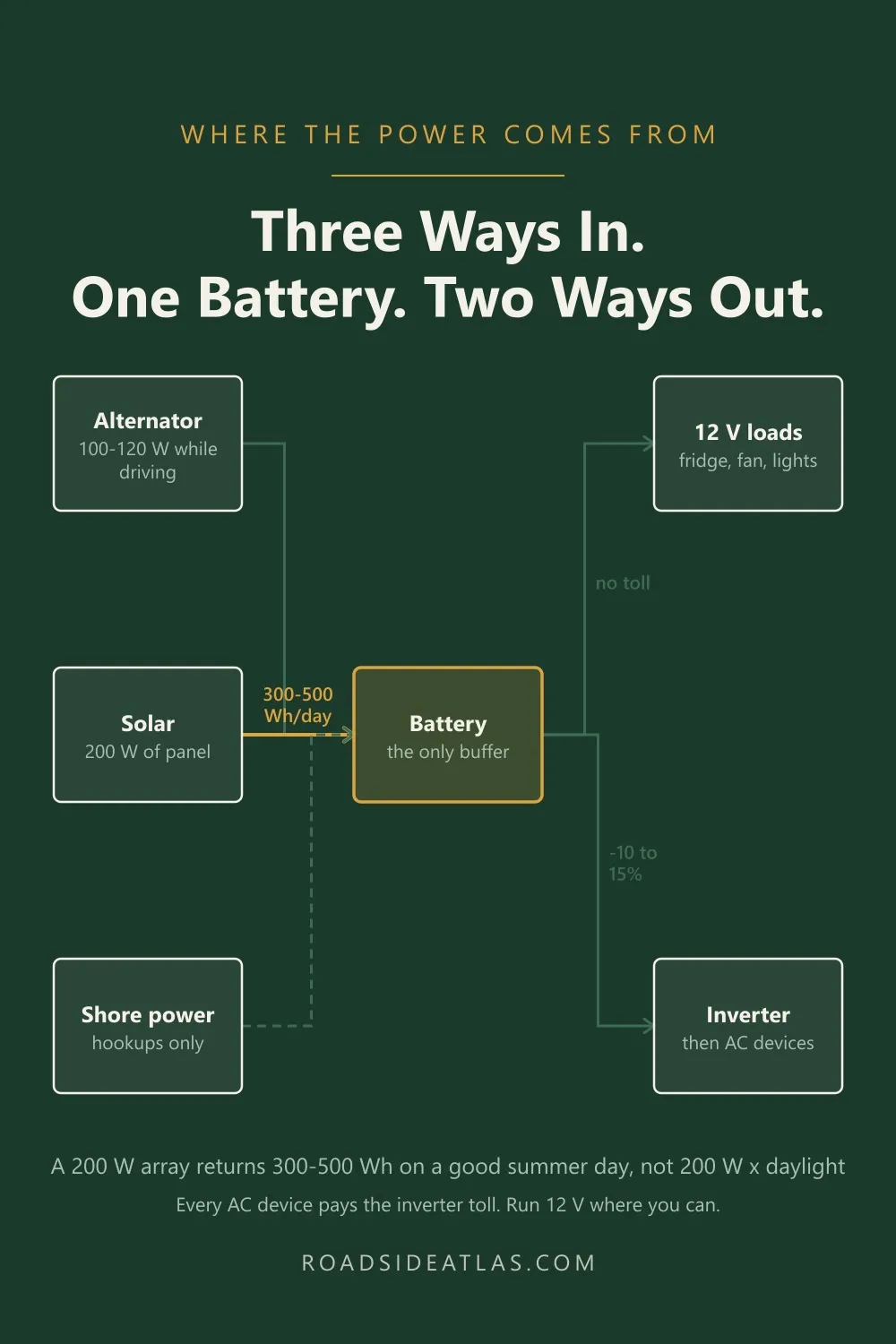
- Inverter losses. Running a 120 V appliance off a battery means converting DC to AC, which costs roughly 10–15%. Anything you plug into a household outlet should be budgeted about 15% higher than the label says.
- Usable capacity is not nameplate capacity. More on this below, and it’s where most people’s arithmetic quietly breaks.
What things actually cost you
Approximate figures for a night or a day of normal use. Your appliances will differ — this is for getting the shape of the problem, not for final sizing.
| Load | Draw | Typical use | Energy |
|---|---|---|---|
| LED lights (whole rig) | 5–10 W | 5 h evening | 30–50 Wh |
| Phone charging, ×2 | — | full charge each | 40–60 Wh |
| Laptop, working | 20–45 W | 6 h | 120–270 Wh |
| Roof vent fan | 12–35 W | 8 h overnight | 100–280 Wh |
| 12 V compressor fridge | 40–60 W cycling | 24 h, mild weather | 250–450 Wh |
| 12 V compressor fridge | 40–60 W cycling | 24 h, hot weather | 450–700 Wh |
| Furnace blower (propane heat) | 70–120 W | cold night, cycling | 150–400 Wh |
| CPAP, no humidifier | 5–15 W | 8 h | 40–100 Wh |
| CPAP, heated humidifier + hose | 30–60 W | 8 h | 200–400 Wh |
| Starlink or similar | 40–75 W | 10 h | 400–750 Wh |
| Electric kettle | 1,200 W | 4 min | ~80 Wh |
| Drip coffee maker | 900 W | 10 min | ~150 Wh |
| Induction burner | 1,500 W | 20 min | ~500 Wh |
| Rooftop air conditioner | 1,300–1,800 W | 1 h | 1,300–1,800 Wh |
Read that table twice and the structure of the problem shows up. Everything electronic — lights, phones, laptops, fans, even a CPAP — is small. The entire top half of the list put together is a few hundred watt-hours. Then heating and cooling appear, and the numbers jump by an order of magnitude.
Heat is the enemy
The dividing line is not “big appliance” versus “small appliance.” It’s whether the device makes heat or moves heat.
Anything with a heating element — kettle, toaster, coffee maker, hair dryer, space heater, induction hob — converts electricity directly into heat, and heat is expensive. Anything that moves heat against a gradient — air conditioner, fridge in hot weather — is running a compressor continuously and is expensive for the same reason.
This is why the standard advice is to keep propane for heating and cooking and reserve electricity for electronics. It isn’t nostalgia for gas appliances. A propane burner and a propane furnace get their energy from a tank you can refill for a few dollars, and they leave your battery to do the job it’s good at: running small loads for a long time.
The corollary is the single most common disappointment in this category: a portable power station will not run a rooftop air conditioner for a meaningful length of time. Even a 2 kWh unit is roughly one hour of air conditioning, assuming its inverter can handle the startup surge at all — most rooftop units pull 2,500–3,500 W for the first second unless a soft-start module has been fitted. Air conditioning genuinely requires shore power or a generator. There is no clever way around it.
What your rig already has
If you’re renting or borrowing, the rig comes with a house battery, and it’s worth knowing what that gives you before you buy anything.
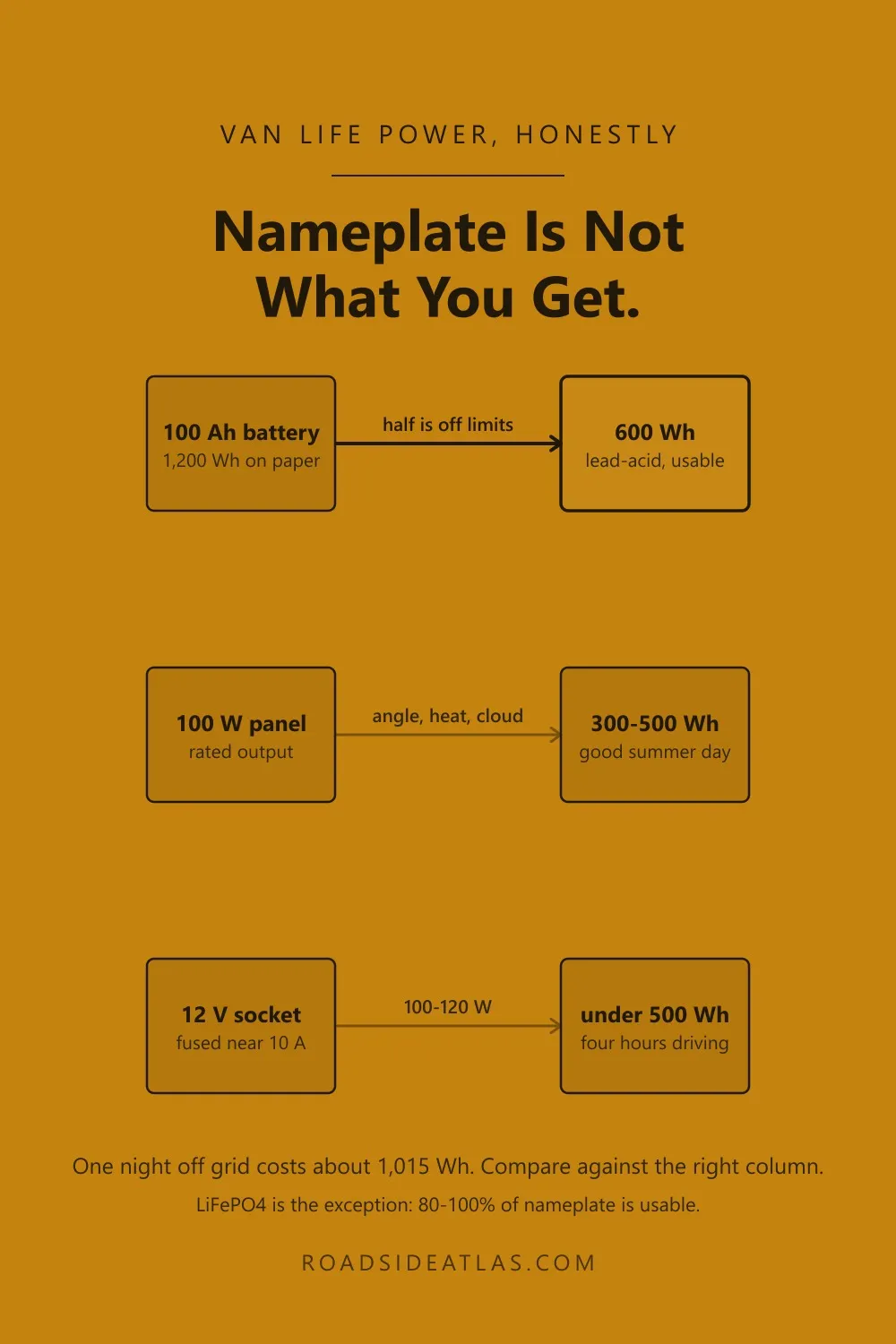
A single 12 V lead-acid house battery rated at 100 amp-hours holds 1,200 Wh on paper. You can only use about half of it. Discharging lead-acid below 50% damages it and sharply shortens its life, so the honest figure is around 600 Wh. Rental fleets and older rigs almost always run lead-acid.
Lithium iron phosphate (LiFePO4) is different: you can use 80–100% of nameplate capacity without harm, so a 100 Ah lithium battery really does give you close to 1,200 Wh. When someone tells you their 100 Ah battery lasts twice as long as yours, this is usually why — not better wiring or a more efficient fridge.
Now put that 600 Wh next to the table above. A cold night with the furnace cycling and a fridge running will consume most of it before morning. That is the entire reason first-time boondockers wake up to a dead battery and a furnace that won’t light: the propane was fine, but the blower needed electricity that wasn’t there.
A worked example
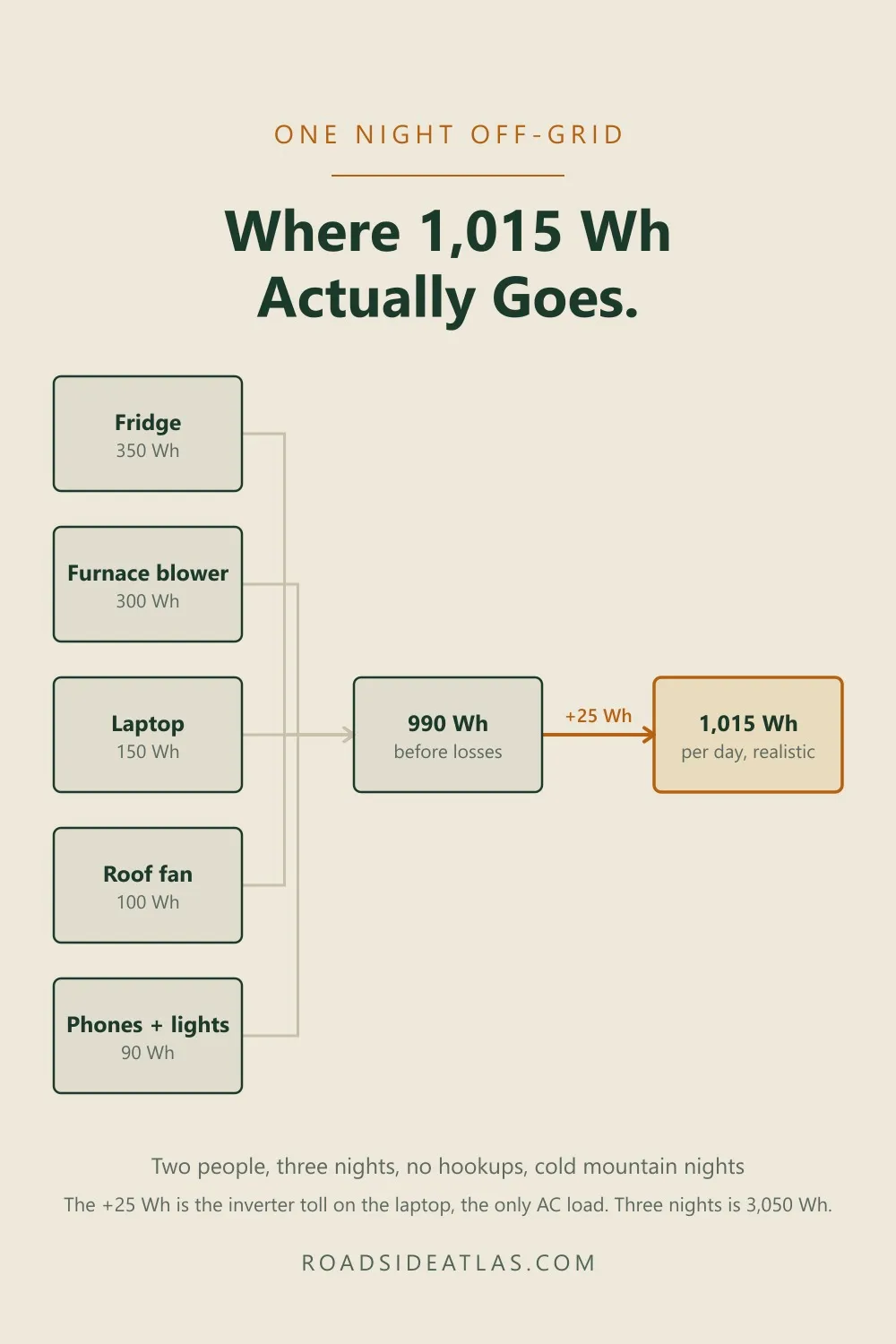
Two people, three nights, no hookups, shoulder season in the mountains. Cold nights, mild days.
| Load | Per day |
|---|---|
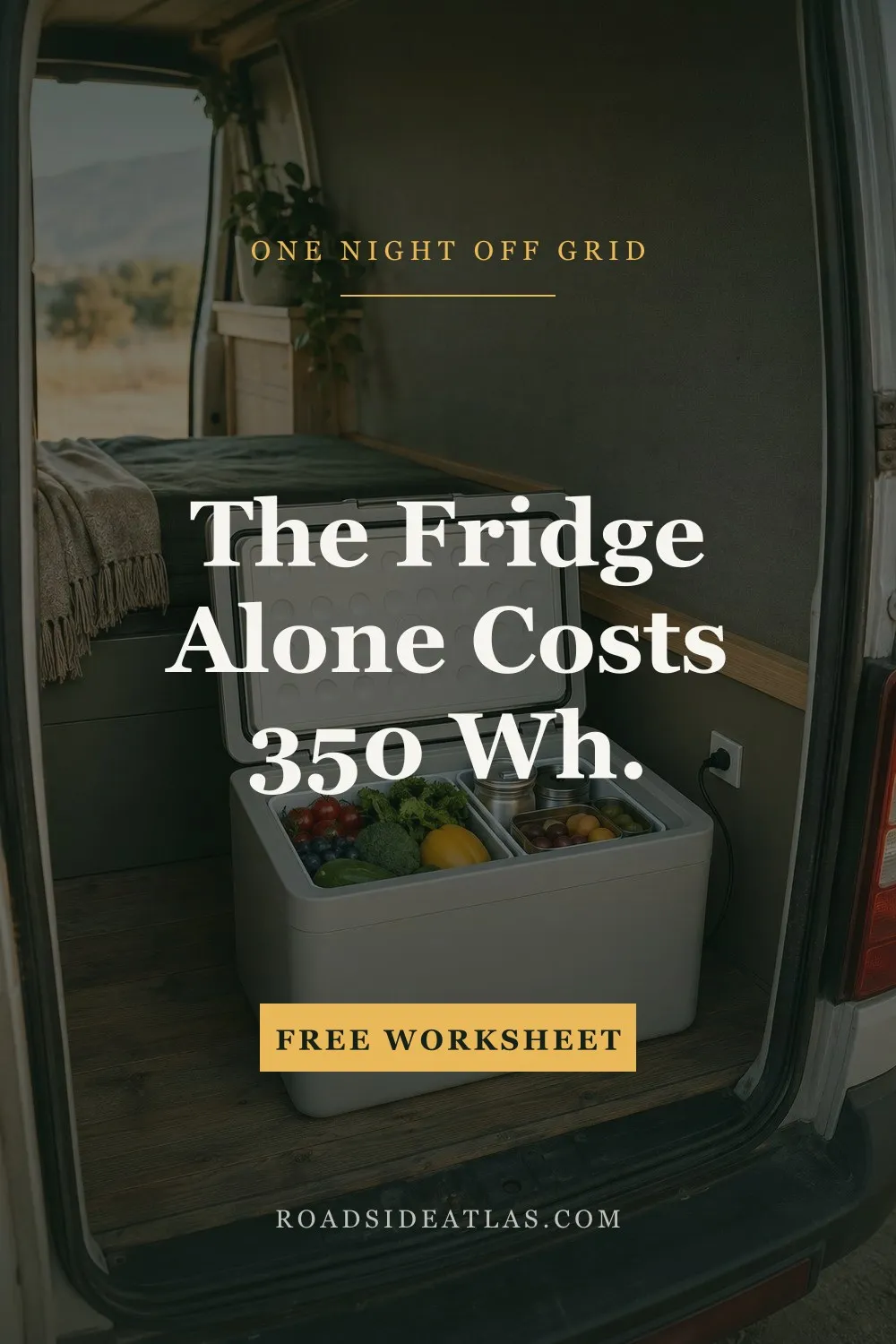
| Fridge (mild) | 350 Wh |
| Furnace blower (cold nights) | 300 Wh |
| Roof fan | 100 Wh |
| Lights | 40 Wh |
| Two phones | 50 Wh |
| One laptop, light use | 150 Wh |
| Daily total | 990 Wh |
| Inverter losses on AC loads (the laptop, +15%) | ~+25 Wh |
| Realistic daily budget | ~1,015 Wh |
Three nights is roughly 3,050 Wh with no recharging at all.
The house battery covers about 600 Wh of that. A 1 kWh portable station covers another night. To do the full three nights on stored energy alone you’d need something around 2.5 kWh on top of the house battery, which is heavy and expensive.
The cheaper answer is almost always to put energy back in rather than to carry more of it, which brings us to the part people skip.

Putting energy back
Driving. The most reliable recharge you have, and the one people forget they already own. The engine’s alternator charges the house battery whenever you’re moving. Many portable stations also accept a 12 V input from the cigarette-lighter socket — but that socket is usually fused around 10 A, so you’re getting about 100–120 W. Four hours of driving is under 500 Wh through that route. A proper DC-to-DC charger moves several times that, but it’s an installed component, so it’s not an option in a rental.
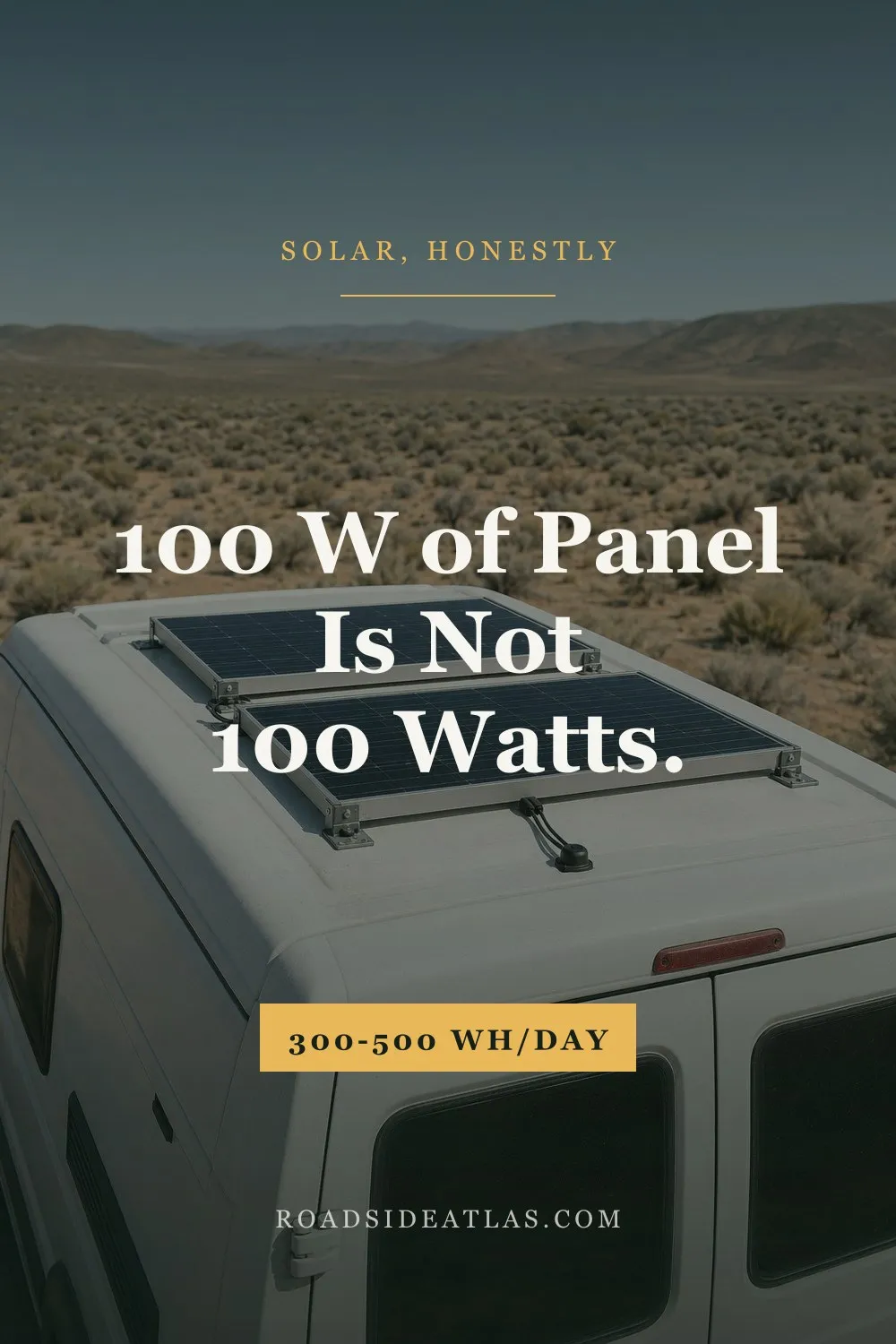
Solar. A 100 W panel does not make 100 W. Between imperfect sun angle, heat derating, cloud, and controller losses, a flat-mounted 100 W panel realistically returns 300–500 Wh on a good summer day and can drop to a third of that in winter, under trees, or on an overcast day. Portable folding panels you can aim at the sun do better per watt than a fixed roof panel, at the cost of setting them out and moving them.
So covering the 1,015 Wh daily budget above from solar alone means something like 250–350 W of panel in good conditions, and it means parking in the open rather than in the shade you’d otherwise want. Solar is excellent for stretching a stay from two days to a week. It is not a substitute for having enough capacity to get through a night.
Generators. They work, they’re loud, and a growing number of campgrounds and dispersed areas restrict their hours or ban them entirely. Worth knowing about, rarely worth carrying for a short trip.

Sizing, in plain bands
Once you have a daily watt-hour number, the choice falls out of it. These bands assume a portable power station, since that’s the only option that works in a rental.
Under 500 Wh. Phones, a laptop, lights, a fan for part of the night. Fine for campgrounds with hookups where you just want convenience, or for a single night out. Light enough to carry with one hand.
500 Wh – 1 kWh. One night genuinely off-grid running either a fridge or a CPAP, but not both plus a furnace. This is the size most people should stop at if they camp with hookups nine trips out of ten and go off-grid occasionally.
1–2 kWh. The practical sweet spot for real boondocking. Covers a full day like the worked example above, with enough margin that a cold night doesn’t end the trip. Combined with recharging while you drive, it supports an indefinite loop of drive-a-bit, camp-a-bit. BLUETTI and Jackery both build heavily in this band, and it’s where the useful features — 1,500 W+ inverters, fast solar input, LiFePO4 cells — become standard rather than premium.
Over 2 kWh. Multi-day off-grid without moving, or you’ve decided you want to cook on induction. Be realistic about the weight: units in this class run 20–30 kg (45–65 lb) and stop being something you casually lift in and out of a vehicle. At this point an installed system starts to make more sense — if you own the rig.
Two numbers matter, not one. Capacity in watt-hours tells you how long. Inverter output in watts tells you what you can run at all. A 1 kWh station with a 600 W inverter cannot boil an electric kettle no matter how full it is. Check the continuous output rating against the largest single thing you intend to plug in.
Work out your own number
Print this, walk through the rig, and write the watt-hours next to each item you’ll actually use. Ignore anything you won’t. The total is your daily budget, and everything else is arithmetic from there.
Or do it on screen: the power station size calculator takes the same list, adds solar, driving and the house battery, and gives you the capacity and inverter rating for the trip.
Off-Grid Power Audit
32 items · 6 categories
Off-Grid Power Audit — roadsideatlas.com
Tick what you'll run, then write watts × hours next to each one. Add 15% to anything that plugs into a household outlet. The total is your daily watt-hour budget.
Runs All Night
- Refrigerator (12 V compressor or absorption)
- Furnace blower — only if nights are cold
- Roof vent fan
- CPAP or other medical device
- Water pump (small, but count it)
- Propane and CO detectors (always on)
Devices
- Phones — one charge each per day
- Laptop or tablet
- Camera and drone batteries
- Headlamp and lantern charging
- Bluetooth speaker
- Starlink or mobile hotspot
Kitchen (the expensive ones)
- Electric kettle
- Coffee maker or grinder
- Induction burner
- Microwave
- Blender
Heating & Cooling
- Rooftop air conditioner — assume shore power only
- Electric space heater — assume shore power only
- 12 V fan
- Electric blanket (12 V versions are cheap to run)
Recharging Sources
- Hours driving per day (alternator or 12 V socket)
- Solar panel wattage installed or portable
- Expected sun: open sky, partial shade, or overcast
- Shore power available on any night of the trip
Check Before You Buy
- Continuous inverter output vs. your largest appliance
- Surge output vs. anything with a motor
- Battery chemistry — LiFePO4 for long life
- Solar input limit (volts and watts)
- 12 V output for a fridge or fan
- Pass-through charging while in use
- Weight — can you lift it into the rig?
Buying notes that aren’t on the box
Chemistry. LiFePO4 cells are rated for something like 3,000–4,000 charge cycles versus a few hundred for the older NMC lithium used in cheaper units. For a station you cycle every night on a trip, that’s the difference between a decade and a couple of seasons. Most current mid-range models have moved to LiFePO4, but the budget end of the market has not, so check.
Cold. Lithium batteries of any chemistry will not accept a charge below about 0 °C (32 °F) unless the unit has an internal heater. Discharging in the cold is fine. If you’re shoulder-season camping at altitude, keep the station inside overnight and expect slower solar charging on frosty mornings.
Pass-through. Being able to charge the station while things are plugged into it sounds obvious and isn’t universal. It’s what lets you leave it on the 12 V socket while driving with the fridge running off it.
Self-discharge. These units lose charge sitting in a garage. Charge to roughly 60–80% for storage rather than full or empty, and top it up a couple of days before the trip rather than the morning of — some take 6+ hours from a wall outlet.
What not to buy
Don’t buy the biggest unit you can afford on the theory that more is safer. Weight is a real cost in a vehicle with a payload limit, and a 30 kg box you resent moving ends up living in a cupboard at home.
Don’t buy a system that requires installation if you’re renting. You cannot drill, wire, or mount anything in someone else’s rig, and peer-to-peer rental agreements through Outdoorsy and RVshare are explicit about modifications. Portable is not a compromise here — it’s the only category that applies.
And don’t buy anything at all before checking what the rig already has. Some rentals come with lithium house batteries and a solar array on the roof, in which case your power problem may already be solved. Ask the owner for the battery type, the amp-hour rating, and the solar wattage before you shop. Those three numbers take one message to get and can save you several hundred dollars.

The short version
Add up watt-hours for one day. Assume half your lead-acid house battery is usable. Assume a solar panel returns three to five times its wattage over a good day, not eight. Keep heat on propane. Size the inverter for your largest single appliance and the capacity for your night.
Do that and the answer stops being a guess. Most people who go through the exercise end up buying something smaller than they were about to.
Figures here are typical ranges for planning, not specifications. Check the label on your own appliances and the rating plate on your rig’s battery before committing to a purchase.