A 7-Day Utah RV Itinerary, Hour by Hour
DisclosureThis page contains affiliate links. If you buy through them, we may earn a commission at no extra cost to you.
Every Utah RV itinerary written before this summer routes you the same way: Zion, then east through the tunnel on the Zion–Mount Carmel Highway, then up to Bryce. It is the obvious line on the map and it has been the standard first leg of the Mighty 5 for decades.
As of 7 June 2026 that road is closed to almost every rental RV. Not restricted, not permit-only. Closed.
So this is a seven-day itinerary built the way the map actually works now: which numbers decide your route, what the detour costs, and where you sleep each night.
The rule that broke every itinerary written before June
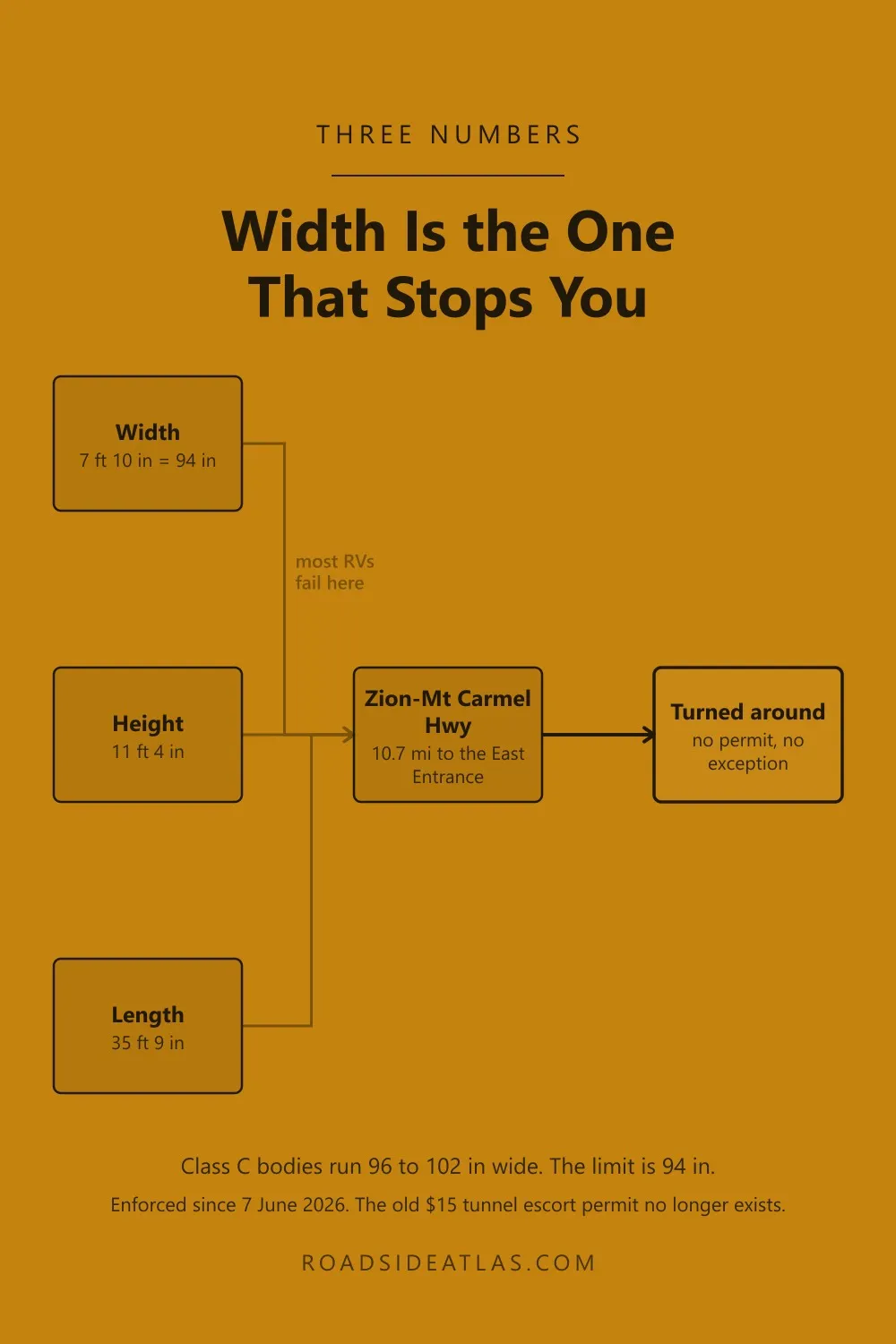
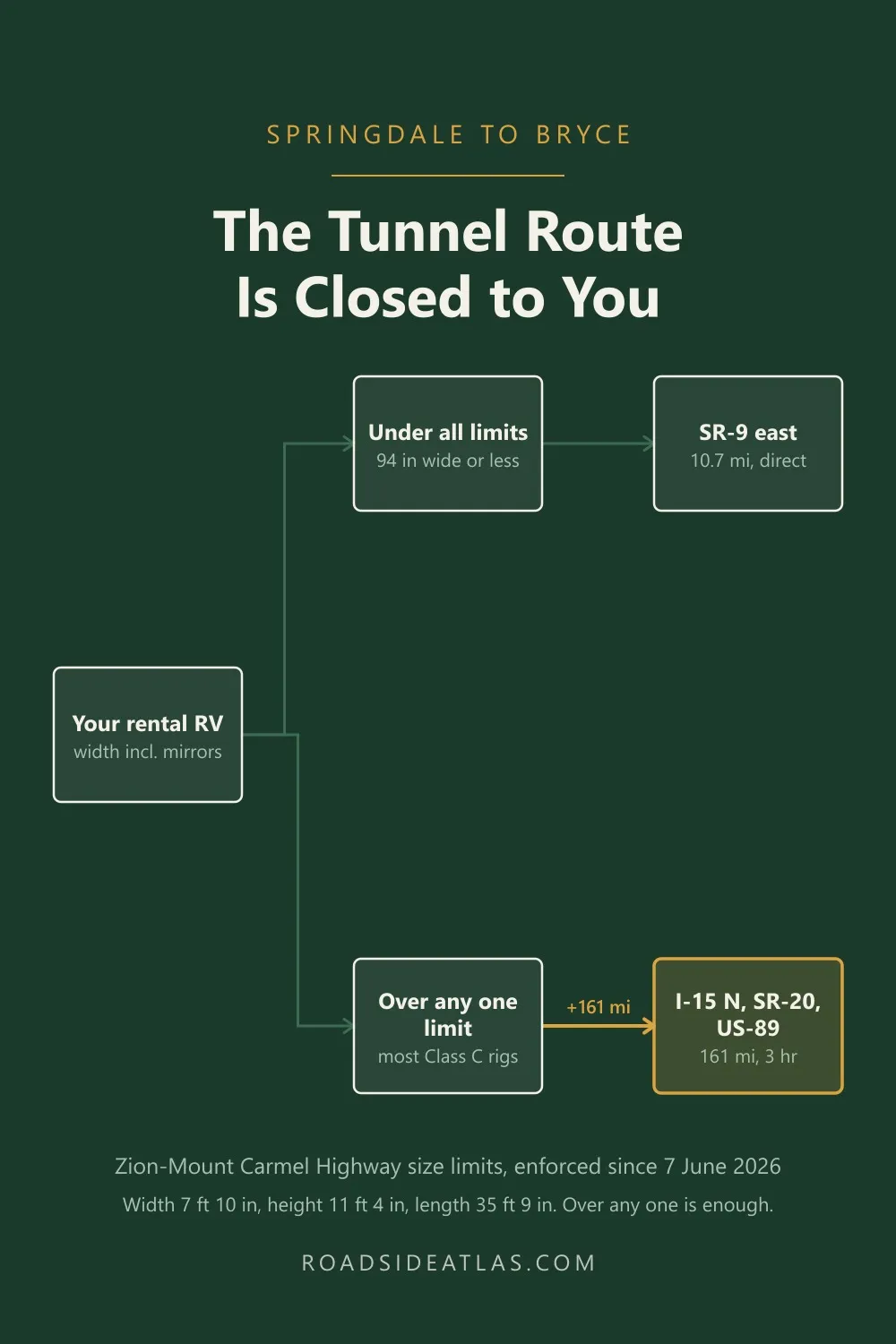
Zion National Park now enforces size and weight limits on the entire 10.7-mile section of the Zion–Mount Carmel Highway between Canyon Junction and the park’s East Entrance. The park announced the change on 5 January 2026 and began enforcing it on 7 June 2026.
| Limit | Figure |
|---|---|
| Length, single vehicle | 35 ft 9 in |
| Width | 7 ft 10 in |
| Height | 11 ft 4 in |
| Weight | 50,000 lb |
| Combined length, vehicle plus trailer | 50 ft |
| Hitch to rear axle | 26 ft |
The part that matters is the one nobody looks at. Seven feet ten inches is 94 inches. Class C motorhome bodies are commonly 96 to 102 inches wide, with 102 inches the legal maximum in most states — and mirrors and awnings sit outside the body. A 24-foot Class C is comfortably inside the length limit and comfortably outside the width limit, which is why renters keep reading the 35-foot number, deciding they are fine, and finding out at the entrance station that they are not.
The old escape hatch is gone too. Until this year an oversize vehicle could buy a $15 tunnel permit and be escorted through by rangers during posted hours. That permit no longer exists. There is no exception to apply for.
What you can still do at Zion
This is not a reason to skip the park, and the coverage that reads that way is wrong.
Zion Canyon — the main canyon, the Narrows, Angels Landing, the Emerald Pools, the lodge, the campgrounds — is all reached from the South Entrance at Springdale, and the South Entrance is unaffected. Oversize vehicles can still enter there, park in the large vehicle lot when space allows, stay in the campgrounds, and reach the lodge.
What you lose is the ability to drive through the park from west to east and come out the other side. That is a routing problem, not a sightseeing problem, and the itinerary below solves it by never needing to drive through.
The second size limit nobody mentions
Bryce Canyon has its own restriction, and it catches people who cleared Zion by parking at the South Entrance.
During shuttle season — typically mid-April to mid-October, while shuttles run 8 a.m. to 8 p.m., or 8 a.m. to 6 p.m. in April and October — vehicles 23 feet and longer are barred from parking at the Visitor Center, Sunrise Point, Bryce Lodge, Sunset Point, Inspiration Point, Bryce Point and Paria View. That is the entire Bryce Amphitheater, which is the entire reason people come.
The park’s answer is straightforward: park the rig at the Shuttle Station in Bryce Canyon City, or at the additional Visitor Center lot, or leave it at your campsite, and take the free shuttle in. Viewpoints along the Southern Scenic Drive, south of Swamp Canyon, have no such restriction.
So the pattern for the whole week is the same one twice: the rig is transport between parks, not transport inside them.
How the drive legs below were worked out
Two of these numbers are official and the rest are not, so here is which is which.
The Zion detour distance and time come from UDOT’s Zion area road restriction page. The Bryce-to-Capitol-Reef time comes from Capitol Reef’s own directions page. The Arches figures come from the park’s directions page. Everything else is ordinary highway mileage — confirm it in your own mapping app before you go, and add time, because a loaded Class C on a mountain grade does not drive like the car the estimate was built for.
All park rules, dates and fees below were read from the National Park Service and UDOT on 3 September 2026. Check the current version before you travel.
| Leg | Distance | Budget |
|---|---|---|
| Las Vegas → Springdale | ~160 mi | 3 hr 30 |
| Springdale → Bryce Canyon, via I-15 and US-89 | 161 mi ★ | 3 hr |
| Bryce Canyon → Capitol Reef, on SR-12 | ~110 mi | 3 hr ★ |
| Capitol Reef → Moab | ~150 mi | 3 hr |
| Moab → Salt Lake City, if you fly out | 236 mi ★ | 4 hr 30 |
★ = published by NPS or UDOT.
Day 1 — Las Vegas to Springdale
Drive: about 160 miles, budget 3 hours 30.
Rental pickups run late morning, and the handoff itself is not a five-minute affair — the pickup inspection is thirty minutes if you do it properly, and it is the thirty minutes that decides who pays for the scuff on the bumper. Do it anyway. Ask for the rig’s width including mirrors while you are standing next to it, and write it down. You will need it twice this week.
Then groceries in St George or Hurricane, because Springdale is a small town with small-town prices, and I-15 north to SR-9 east.
Sleep: Watchman Campground, inside the park by the Visitor Center. Standard sites are reservable up to six months in advance on recreation.gov and they go. Check on the listing which loop you are booking and what it comes with, because the park campgrounds are not uniformly serviced. The alternative is a commercial RV park in Springdale, Virgin or Hurricane, where full hookups and a dump station are a given.
Day 2 — Zion, and no driving at all
Drive: none. Leave the rig where it is.
The Zion Canyon shuttle is mandatory during shuttle season, which in 2026 runs daily from 17 May to 24 October, with reduced service to 28 November. Private vehicles cannot drive the Zion Canyon Scenic Drive while the shuttle is running. No ticket or reservation is needed to ride it — you queue, you board. The free Springdale Line runs nine stops through town to the pedestrian entrance every 10 to 15 minutes, which is why staying in Springdale works even without a car.
Angels Landing needs a permit, and there are two ways to get one:
- The seasonal lottery, which you apply to months ahead. For hikes in September, October and November 2026, applications were open 1–20 July and permits issued on 25 July. December through February hikes are applied for 1–20 October.
- The day-before lottery, which opens at 12:01 a.m. and closes at 3 p.m. Mountain Time the day before your hike.
Both cost $6 to apply, covering up to six people, plus $3 per person if you win. Seasonal-lottery permits can be cancelled for a refund up to two days before; day-before permits cannot.
If you do not have a permit, the Narrows from the bottom needs no permit at all, and the West Rim Trail to Scout Lookout gets you the view without the chains.
Day 3 — Springdale to Bryce, the long way round
Drive: 161 miles, budget 3 hours.
This is the leg the rule changed. You drive SR-9 west out of Springdale — the restricted section is east of Canyon Junction, so this direction is fine — then I-15 north to SR-20, then US-89 south, then SR-12 east to the park. UDOT publishes it as 161 miles, roughly 2.5 to 3 hours.
Two warnings, both worth taking seriously.
Your navigation app will try to send you through the tunnel. It is the shortest line and the app does not know how wide your rig is. Set the route manually before you pull out.
It will also offer you Sheep Bridge Road or Smithsonian Butte Road as clever shortcuts. UDOT specifically says these are not recommended for oversize vehicles. They are unpaved. Do not take a rented motorhome down either of them.
There is a second official detour — SR-59 to Arizona SR-389 to US-89, 80 miles and about 1.5 to 2 hours — but it delivers you to Kanab and the south, not to Bryce. Note it for a Grand Canyon North Rim variant, not for this week.
Sleep: North Campground or Sunset Campground inside Bryce, or an RV park in Bryce Canyon City. Bryce sits at over 8,000 feet and gets cold at night in every season. Check what your rental’s heater runs on and whether the propane tank is full before you leave Springdale.
Day 4 — Bryce Canyon
Drive: a few miles, and park once.
Take the rig to the Shuttle Station in Bryce Canyon City, or leave it at the campsite, and ride in. If your rental is 23 feet or longer you have no choice about this between 8 a.m. and 8 p.m. anyway.
Sunrise Point deserves its name and the crowd is thinnest before the first shuttle. The standard combination is down the Navajo Loop and back up Queen’s Garden, which puts you among the hoodoos rather than looking at them from a railing. At 8,000 feet, with a day of driving behind you, budget more time than the mileage suggests.
Late afternoon is the one time to take the rig out: the Southern Scenic Drive has no oversize parking restrictions, and Rainbow Point at the end is 9,100 feet of very different country.
Day 5 — Bryce to Capitol Reef on Scenic Byway 12
Drive: about 110 miles, budget 3 hours — the park’s own figure.
This is the best road of the week and the one that most deserves the extra hours. Capitol Reef’s directions page puts it at about three hours on SR-12, and warns that the route crosses a 9,600-foot summit on Boulder Mountain which can be hazardous in winter. In an RV, in any season, drive it as a mountain road: low gear on the descents, and do not ride the brakes down the far side.
The park also says plainly: do not follow GPS onto South Draw Road. It is unmaintained, high-clearance 4WD, and explicitly not suitable for RVs.
Capitol Reef itself is the quietest of the five and the one people ration their time on. The Scenic Drive south from Fruita, the orchards, and Gifford House are a half-day if you let them be.
Sleep: Fruita Campground inside the park, or Torrey, eleven miles west, which has commercial RV parks with hookups.
Day 6 — Capitol Reef to Moab
Drive: about 150 miles, budget 3 hours.
UT-24 east to I-70, then US-191 south. The I-70 stretch across the San Rafael Swell is empty, fast and one of the better pieces of interstate in the country, which after two days of switchbacks is exactly what you want.
Arrive in the early afternoon, because Moab is where you restock, do laundry, dump the tanks and fill fresh water for the first time since Springdale. Moab has more full-hookup RV parks than the rest of this itinerary put together. Use one.
Sleep: a commercial RV park in Moab, or Devils Garden Campground inside Arches if you booked it a long time ago.
Day 7 — Arches and Canyonlands
Drive: 5 miles to the Arches entrance, and about 30 more to Island in the Sky.
There is no timed entry reservation at Arches in 2026. The pilot ran for four seasons and ended on 31 December 2025; the park announced on 18 February 2026 that it would not require reservations this year. Almost everything written about visiting Arches still tells you to book a slot. You do not need one. You need an entrance pass — $30 per vehicle for seven days — and you need to arrive early, because the parking lots at Delicate Arch and Devils Garden fill and the queue at the entrance station is now the constraint the reservations used to manage.
Delicate Arch at first light, Windows and Double Arch on the way back out, then Canyonlands’ Island in the Sky in the afternoon for Mesa Arch and Grand View Point. Two parks in a day is aggressive, and it is the last day, so it is the right day to be aggressive.
If the rental has to go back to Las Vegas
This is a one-way itinerary, and that is the honest cost of it. Ending in Moab means either a one-way drop fee, or a long repositioning day.
Flying out of Salt Lake City is the cleanest exit — the park’s own directions page puts Arches 236 miles southeast of Salt Lake, which is a comfortable half-day. Grand Junction is closer still at 109 miles.
If you must return to Las Vegas, do not try to squeeze it into day 7. Add an eighth day, or cut Moab entirely and run the three-park version: Zion two nights, Bryce two nights, Capitol Reef two nights, back to Las Vegas via I-70 and I-15 on day 7. It is a better trip than a rushed five-park version, and it is much better than the version where you drive 450 miles on the day the rig is due back.
Check the one-way drop fee before you book. On Outdoorsy and the other peer-to-peer platforms most rigs are listed by owners who want them back where they started, so a one-way is often not offered at all — which means the decision between the five-park and three-park versions gets made at booking, not on day 6.
Before you book
Utah RV Trip: What to Settle Before You Book
21 items · 4 categories
Utah RV Trip: What to Settle Before You Book — roadsideatlas.com
The first three items decide your entire route. Do them before you reserve anything else.
The measurements that decide the route
- Rig width including mirrors, from the listing or the owner (Zion limit: 7 ft 10 in)
- Rig height including air conditioner (Zion limit: 11 ft 4 in)
- Rig length (Zion limit: 35 ft 9 in; Bryce parking limit: under 23 ft)
- If towing: hitch to rear axle under 26 ft, and 50 ft overall
- One-way drop-off offered, and what it costs
Reserve, in this order
- The RV itself, for the dates you actually want
- Watchman Campground, Zion — up to 6 months ahead on recreation.gov
- Bryce Canyon campground or an RV park in Bryce Canyon City
- Fruita Campground, Capitol Reef, or an RV park in Torrey
- A full-hookup RV park in Moab for the last two nights
- Angels Landing seasonal lottery, if your dates are known months out
The week before
- Set the Springdale-to-Bryce route manually: I-15 north, SR-20, US-89
- Confirm the Zion shuttle is running on your dates
- Check SR-12 road conditions over Boulder Mountain
- Buy the entrance pass, or the annual pass if you are visiting four or more parks
- Download offline maps: coverage is poor between Bryce and Capitol Reef
Day of pickup
- Full pickup inspection with the host, photographed in the app
- Width, height and length written down and put on the dash
- Propane full — Bryce is over 8,000 ft and cold at night
- Fresh water filled, black and grey tanks empty
- Groceries in St George or Hurricane, not Springdale
The short version
Measure the rig before you plan the route, not after. Width is the number that disqualifies you, and it is the number nobody prints on the listing. Once you know it, the rest of the week falls out: you approach Zion from the south and leave the way you came, you go north and over to reach Bryce, and from there the road runs east all the way to Moab.
Nothing about that is worse than the old route. It is just three hours instead of ninety minutes on one day out of seven, and it is the only version that does not end at a ranger turning you around at the entrance to a tunnel.