Generator vs Battery: The 10-Year Cost of Power
DisclosureThis page contains affiliate links. If you buy through them, we may earn a commission at no extra cost to you.
A generator is usually cheaper to buy and can keep making electricity as long as you can refuel it. A lithium power station costs more up front, runs quietly, and avoids storing gasoline—but its usable energy is finite and it must be recharged.
The fair comparison is not “gas is free” versus “solar is free.” It is the cost of buying the equipment, the fuel or electricity used, upkeep, and the amount of power each option can actually deliver for your campsite and appliances.
Start with a realistic daily load
Consider a small two-person RV using about 1,000 Wh a day for a fridge, lights, phones, fan, and laptop, without air conditioning or electric cooking. That is 1 kWh per day or 365 kWh in a full year. Your own loads may be much lower or higher; our RV power guide shows how to calculate them from appliance watts and hours.
One day of 1,000 Wh is half of a nominal 2 kWh battery before inverter loss and other system limits. In practice, plan on less than the nameplate capacity. Recharging from solar also depends on panel size, shade, weather, season, and where the panels can be placed.
The equipment examples
For a portable generator, use the Honda EU2200i as a reference point: Honda lists a $1,199 MSRP, 2,200 starting watts, and 1,800 rated watts. It is a gasoline inverter generator. The price is an MSRP checked September 15, 2026, not a retailer quote or a promise of availability.
For a battery, use a 2 kWh lithium iron phosphate power station as the reference class. The Jackery Explorer 2000 v2 lists 2,042 Wh, 2,200 W output, and 4,000 cycles to at least 70% capacity; Jackery lists a 3-year standard warranty plus 2 years when bought through eligible channels. The EcoFlow DELTA 2 Max lists 2,048 Wh, a 2,400 W AC output, 3,000 cycles to 80% capacity, and a 5-year warranty. Both makers’ pages show changing prices and promotions, so use the live checkout price for your comparison.
These products are examples, not a claim that one specific generator and battery are exact substitutes. Starting surge, outlet type, charging source, temperature, and runtime differ.
Fuel math: small loads can make a generator look expensive
The generator’s fuel bill depends on how many hours it runs and the load during those hours. Honda’s runtime figures are stated at specified loads; you should use its manual for the exact operating conditions. To make the arithmetic transparent, assume the generator burns 0.10 gallon per hour at the load you actually run. That is a scenario input, not a universal consumption rating.
The EIA reported U.S. regular gasoline at $4.157 per gallon for the week of September 7, 2026. At that price and assumed burn rate, 1,000 Wh generated over five hours (200 W average output) uses 0.5 gallon and costs about $2.08 per day in fuel. If you run it 200 days a year, that is about $416 per year or $4,157 over ten years, before maintenance and any changes in fuel prices.
| Use pattern | Fuel per day at 0.10 gal/hour | Fuel cost at $4.157/gal | Ten-year fuel cost |
|---|---|---|---|
| 1,000 Wh in 5 hours, 30 days/year | 0.50 gal | $2.08 | $624 |
| 1,000 Wh in 5 hours, 100 days/year | 0.50 gal | $2.08 | $2,079 |
| 1,000 Wh in 5 hours, 200 days/year | 0.50 gal | $2.08 | $4,157 |
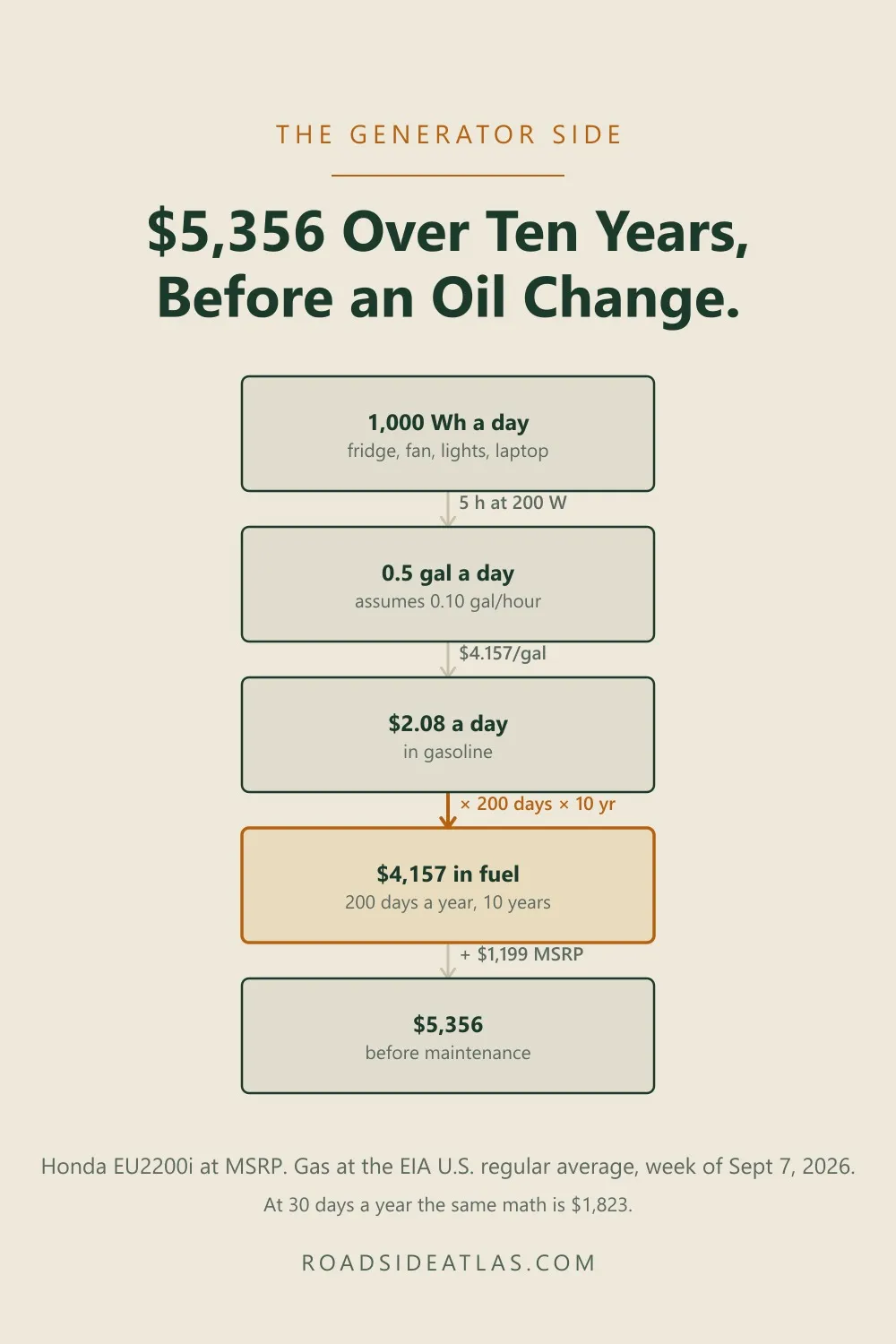
The formula is: runtime hours × gallons per hour × local price × days used. For your rig, plug in the actual load and the generator’s fuel-use data at that load. The EIA weekly gasoline series makes clear why a ten-year projection should be a scenario rather than a precise forecast.
Battery math: cycle life is not the only life limit
At 1,000 Wh per day, 200 use-days each year, you consume 200 kWh per year or 2,000 kWh over ten years. Battery wear is usually counted in full-capacity equivalents: drawing 1 kWh from a 2 kWh station is about half a cycle. In this example, 1 kWh on 200 days equals about 100 full 2 kWh cycles annually, around 1,000 over ten years. If you drained the full 2 kWh on each of those days instead, it would be about 200 cycles a year.
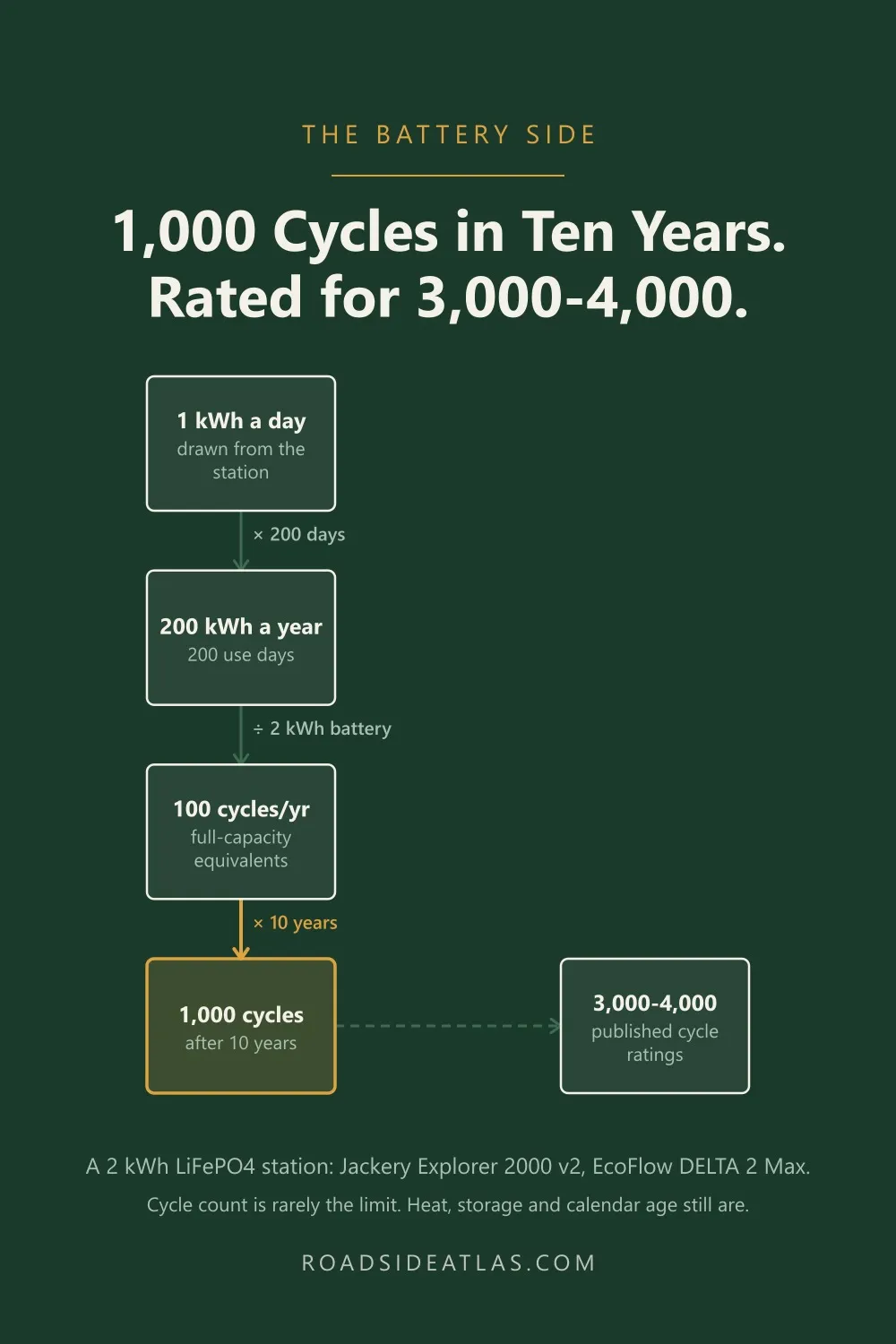
That is below the published 3,000–4,000 cycle figures for these example products, but cycle ratings are measured under specified conditions and do not guarantee a ten-year service life in every climate or storage pattern. Calendar aging, heat, deep discharge, storage state of charge, and warranty exclusions still matter. Follow the manufacturer’s storage guidance and compare the warranty definition, not only the cycle count.
The battery’s operating cost is also not zero. Grid charging costs the local electricity rate, and solar charging requires panels, cables, and enough sunlight. If the panel is shaded at the campsite or you leave before it replenishes the battery, you may need shore power, vehicle charging, or a generator anyway.
An illustrative 10-year total
Use current checkout prices and your real use pattern. Here is how to assemble the comparison without hiding assumptions:
| Cost line | Generator | Battery station |
|---|---|---|
| Equipment | Current generator price | Current 2 kWh station price |
| Fuel or grid energy | Runtime × burn rate × fuel price | Wh recharged × electricity rate, or include solar equipment |
| Maintenance | Oil, spark plug, air filter, and storage items per manual | Usually less routine service; include replacement if needed after warranty |
| Operating constraints | Outdoor placement, fuel handling, noise rules, run-hour limits | Finite stored energy, recharge time, temperature and solar limits |
| Replacement | Include if your annual hours exceed the product’s service expectations | Include if battery aging or warranty period makes replacement likely |
For the generator scenario above, equipment at MSRP plus fuel at 200 days per year is about $5,356 over ten years before maintenance ($1,199 + about $4,157). The 30-day-per-year case is about $1,823 before maintenance. A battery breaks even against that fuel line only if its actual purchase price, charging energy, panels, and any replacement total less than the generator’s comparable equipment, fuel, and maintenance. At light use, the generator may remain cheaper; at frequent use, fuel and noise can make the battery more attractive.
This is deliberately not a headline verdict. Actual generator fuel burn at a small load can differ substantially from the assumed 0.10 gallon/hour, the EIA price is a single week, and today’s product prices change. Replace both inputs before making a purchase decision. We exclude resale value and discounting, which would require an assumption about future value and financing.
The load can decide before the cost
A portable power station may have enough watt-hours for electronics and still lack the output or surge capacity for an appliance. Conversely, a generator may have enough output but violate quiet hours or be prohibited at the campsite. Read the appliance’s running watts and startup surge, the product’s continuous rating, and the site’s generator rules.
Neither of these example systems is a practical way to run an RV rooftop air conditioner all day. The energy requirement is high, and the AC’s startup surge can exceed an inverter’s rating. For air conditioning, compare shore power, an RV-installed generator, or a carefully engineered larger system. Do not buy a small battery based on a headline “appliance runtime” that assumes a different load.
A decision rule that uses your trip
Choose a generator when you need long runtimes or high output, use it only occasionally, have a safe outdoor setup, and the campground permits it. Choose a battery when your normal loads are moderate, quiet operation matters, you can recharge between use periods, or you already have solar that can replenish it. Many RV travelers use a battery for everyday loads and reserve a generator for backup or unusually heavy demand.
Before checkout, calculate your watt-hours, list the appliances that must run simultaneously, check local fuel prices, and read the campsite’s operating rules. Then run the ten-year formula with a low-use, expected-use, and heavy-use case. That will tell you more than a comparison of product labels alone.