The RV Water System, Explained Without the Jargon

DisclosureThis page contains affiliate links. If you buy through them, we may earn a commission at no extra cost to you.
Every RV handover contains the same ninety seconds. The host points at a panel, says “fresh, grey, black,” points at two caps behind a hatch, says “this one’s city water,” and moves on to the propane. You nod. Twenty minutes later you are alone with the rig and you have no idea which cap was which.
None of it is complicated. It is just unfamiliar, and it is explained badly because the people explaining it stopped noticing years ago. Here is the whole system in one read: three tanks, two inlets, one dump order.
The three-tank system, in plain terms
A house has one water pipe in and one drain out, and the drain is somebody else’s problem the moment it leaves the building. An RV has no drain. Everything you use has to be carried with you until you reach somewhere legal to empty it — which is why one pipe becomes three tanks.
| Tank | What goes in | What it does | What goes wrong |
|---|---|---|---|
| Fresh | Clean water you fill it with | Supplies every tap, the shower and the toilet when you are not plugged into a hookup | Freezes in cold weather; goes stale and smells if it sits full for weeks |
| Grey | Kitchen sink, bathroom sink, shower | Holds used water until you can dump it | Food scraps and grease build up at the drain and the low points |
| Black | The toilet, and nothing else | Holds solid waste and paper | Too little water per flush lets solids dry and stack up — the “pyramid” |
Two things follow from that table, and they are the two things people get wrong.
Grey and black are not the same thing with different names. They are separate tanks with separate valves, filled by separate drains. The sink does not go to the black tank. The toilet does not go to the grey tank.
The tank gauges lie. On the black tank especially, the sensors sit inside the tank wall and get coated by exactly the material they are meant to measure. A black tank that reads two thirds full immediately after a dump is usually a fouled sensor, not a failed dump. Learn what your rig’s tanks sound like and how long they take to fill; the panel is a hint, not a measurement.
Your rig’s numbers are not generic
Capacities vary by a factor of two or more between classes, and the ratios between the three tanks change with them. Two Winnebago floorplans, from their published specifications, read on 5 September 2026:
| Travato 59G (Class B van) | Minnie Winnie 22M (Class C) | |
|---|---|---|
| Fresh | 18 gal | 40 gal |
| Grey | 14 gal | 45 gal |
| Black | 11 gal | 40 gal |
| GVWR | 9,350 lb | 14,500 lb |
Look at the first two rows on the van. The grey tank is smaller than the fresh tank. Most of the fresh water you use ends up in the grey tank, so on that rig the grey tank fills before the fresh tank empties, and grey is what ends your stay. On the Class C it is the other way round — 45 gallons of grey against 40 of fresh — and fresh is the constraint.
That is a two-second check on your own rig’s spec sheet, and it tells you which tank to watch. Nobody mentions it at the handover.
Filling up: city water vs the fresh tank
Behind one hatch there are usually two connections, often unlabelled or labelled in worn lettering, and they do completely different jobs.
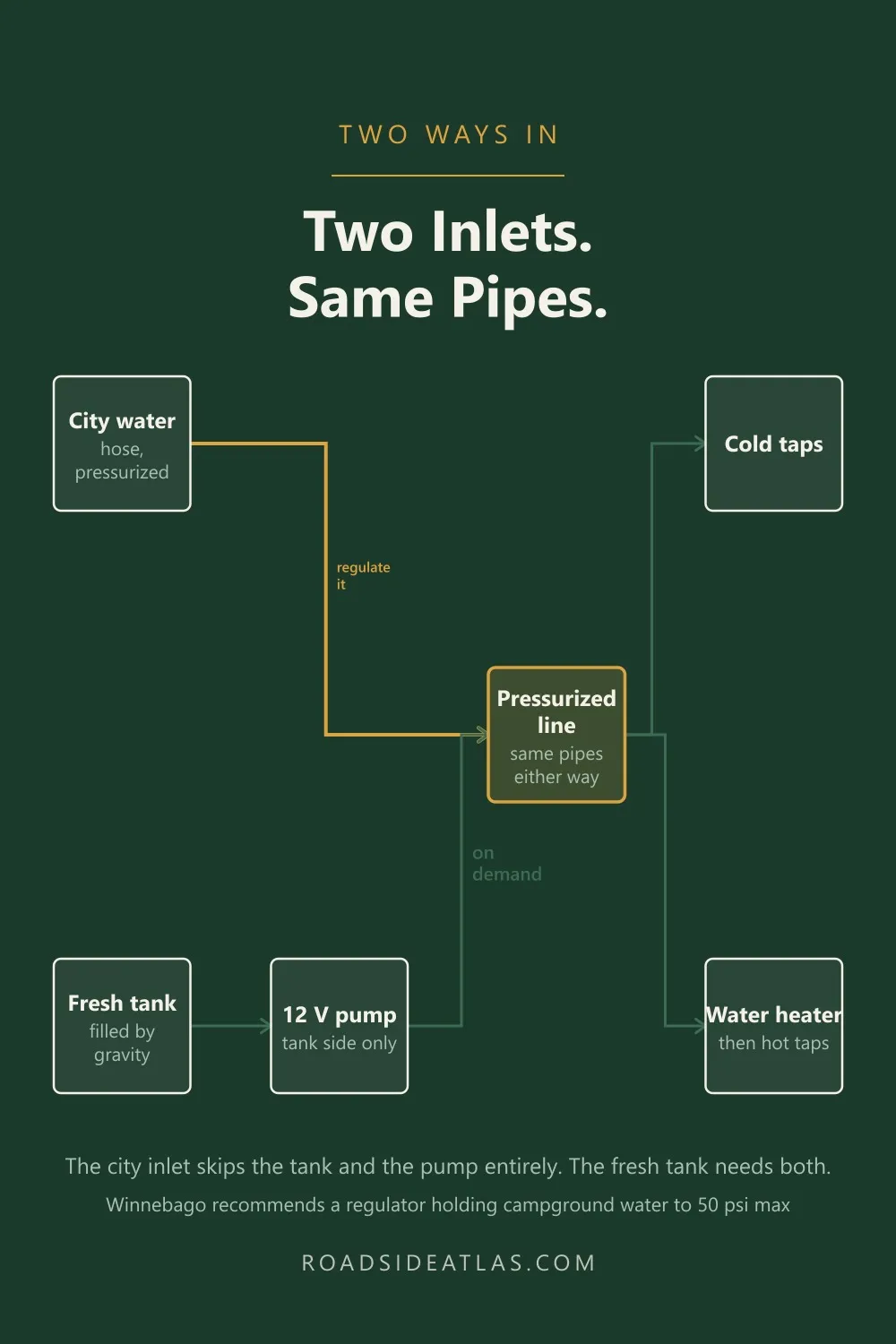
City water is a threaded inlet that takes a hose from the campground spigot. Water arrives already pressurized, goes straight into the rig’s plumbing, and does not fill the fresh tank. Unhook the hose and you have no water from it.
Fresh water fill is a wider opening that takes a hose loosely, or a funnel. It fills the onboard tank by gravity. Water goes in, nothing comes out of the taps until the pump is on.
Which one you want depends on one question: are you staying put at a site with hookups, or leaving?
- Staying at a full-hookup site — use city water. Unlimited supply, house-like pressure, and the pump stays off.
- Boondocking, or driving somewhere without hookups — fill the fresh tank. That is the only water you will have.
- Both, on the same trip — fill the fresh tank before you leave the hookup site. It costs nothing and it is the difference between arriving with water and arriving without.

Put a pressure regulator between the spigot and the inlet, every time. Campground water pressure is whatever the campground’s system happens to be doing, and it is not designed around your plumbing. Winnebago, testing regulators for its own owners, measured a spigot at 115 psi and recommends regulators that hold water to 50 psi maximum. A regulator is a small brass fitting that costs less than one night’s site fee, and it lives on the packing list for a reason.
From tank to faucet: pump, heater, pressure
The 12 V pump. When you are on the tank rather than a hookup, the pump is what moves water. It runs off the house battery, it switches on by itself when you open a tap, and it is loud — a rhythmic clicking from under a bed or a bench. That is normal. What is also normal: the first few seconds of air and spitting after you fill the tank, while the pump pushes air out of the lines. Leave the tap open until it settles.
Two things worth knowing. The pump only draws from the fresh tank, so on city water the pump does nothing — leave it off and it will not run dry. And the pump’s flow is its own rating, not the campground’s, so the shower will be weaker on the tank than on a hookup. That is not a fault.
The water heater. Most RV water heaters run on propane, on 120 V shore power, or on either, switched from a panel inside. Propane heats faster and works anywhere; electric costs nothing at a powered site but does nothing when you are unplugged. The panel layout differs by rig, so find the switch at the handover and ask which mode it is in — a cold shower on the first morning is almost always a heater left in electric mode on a rig that is not plugged in.
Pressure. Two separate things share the word. On a hookup, pressure comes from the campground and the regulator is what stands between it and your pipes. On the tank, pressure comes from the pump and is fixed by what the pump can do. If the shower is weak on the tank and fine on the hose, nothing is broken.
Grey water and black water: what goes where
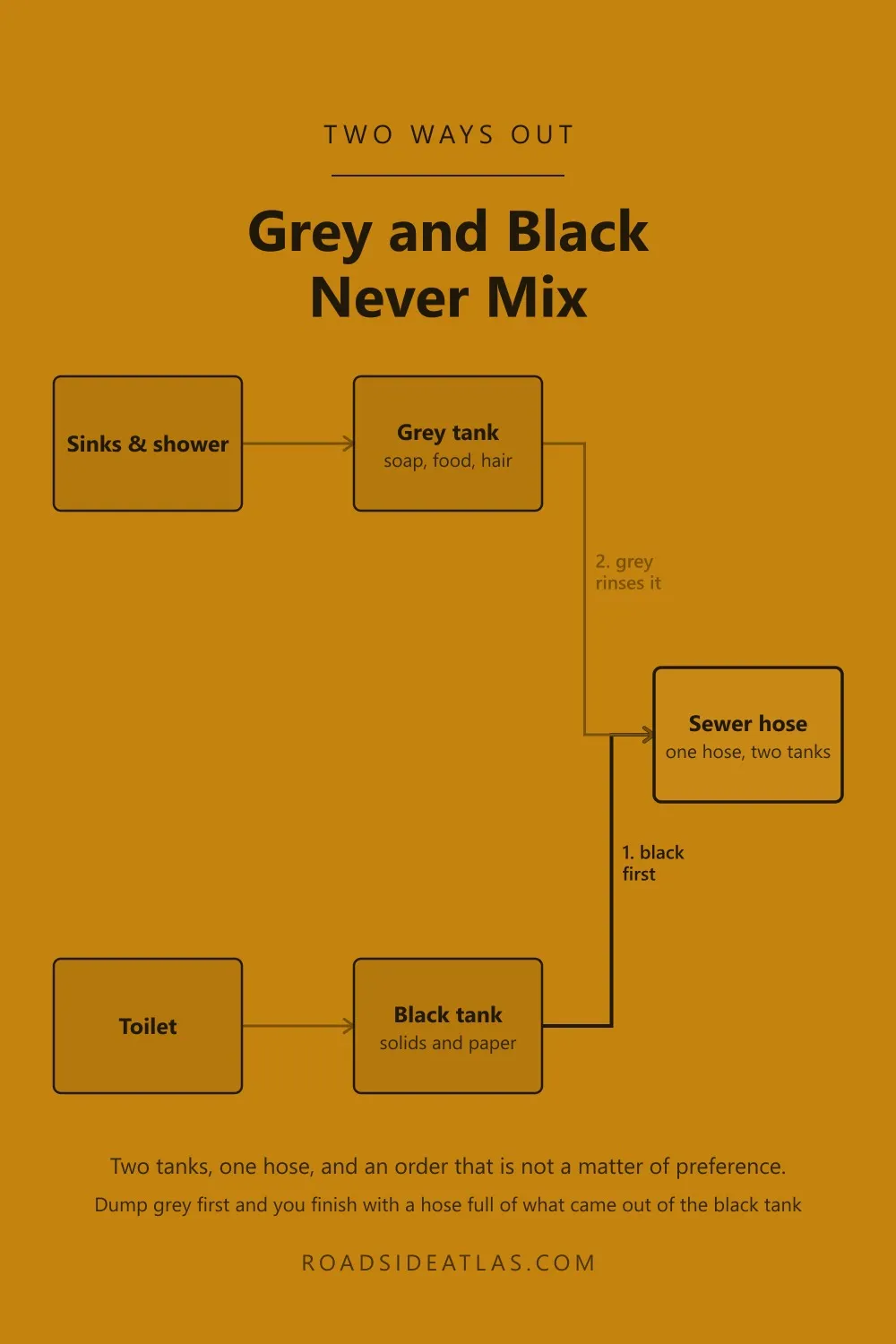
Sinks and shower drain to grey. The toilet drains to black. That is the whole rule, and the reason it matters is not etiquette — it is that the two tanks fail in different ways.
Grey fails by silting up. Food scraps, grease and hair go down the kitchen and shower drains, settle at the low points of the pipe and in the bottom of the tank, and the drain slows. The fix is upstream of the plumbing: wipe plates with a paper towel before washing, use a sink strainer, and keep cooking fat out of the sink entirely.
Black fails by drying out. This is the one that surprises people, because it is the opposite of what you would expect. A house toilet has used at most 1.6 gallons per flush since the federal standard took effect in 1994, and an efficient one uses 1.28. An RV toilet uses a fraction of that — you control it with a pedal, and the instinct is to use as little as possible, because the tank is small and you can see the gauge.
That instinct is what wrecks the tank. Solids need enough water to float and break up. With too little, they dry into a cone under the toilet and stack upward until the pipe is blocked — the “pyramid,” and it is the single most common serious failure in an RV bathroom. The fix is free: hold the pedal longer, and add extra water before and after anything solid.
Two more black-tank rules, both cheap to follow and expensive to ignore:
- RV-rated toilet paper, or nothing. It is designed to break apart in a small volume of water. Regular paper does not, and wet wipes never do, whatever the packet says about flushability.
- Never travel with the black valve open, even at a full-hookup site. Liquid drains away and the solids stay behind and dry out. An open valve is the fastest route to a pyramid there is.

Smell is almost always a symptom of one of the above, not a leak. A black tank that has not had enough water, or a shower or sink trap that has dried out from disuse, will both put an odour into the rig. Run the dry drain for ten seconds and add water to the black tank before you go looking for anything worse.
Dumping correctly: order, hose, mistakes
The order is not a preference. Black first, then grey. The grey water is soapy and comparatively clean, and running it through the hose afterwards rinses out what the black tank just left there. Do it the other way round and you finish the job with a hose full of black water and no way to flush it.
The whole sequence, at a dump station:
- Gloves on. They are for sewer use and nothing else. Keep them separate from every other glove in the rig.
- Connect the sewer hose to the rig’s outlet and lock it, then put the other end into the ground inlet and weight it or use the fitting. A hose that jumps out mid-dump is the worst thing that can happen at a dump station.
- Open the black valve. Let it run until it stops, which takes longer than you expect.
- Close the black valve. Fully.
- Open the grey valve. Let it run through the same hose. This is the rinse.
- Close the grey valve, disconnect at the rig end first, rinse the hose out, stow it in its own compartment.

Fit a clear elbow between the hose and the rig. It is a short transparent fitting, it costs a few dollars, and it is the only way to see when the black tank is actually running clean instead of guessing. Everyone who has one considers it the best money they have spent on plumbing.
The mistakes that cause the problems, all of them avoidable:
| Symptom | Likely cause | What to do |
|---|---|---|
| Tap spits air, then runs fine | Air in the lines after filling the tank | Nothing. Leave the tap open until it clears |
| Nothing from the tap at all | Empty fresh tank, pump switched off, or you are on the city inlet with no hose connected | Check which inlet you are actually using before you check anything else |
| Weak shower on the tank, fine on the hose | The pump’s own flow rate | Nothing is broken. Expect less on the tank |
| Pressure surges or bangs on a hookup | No regulator, or a failed one | Fit a regulator. Winnebago’s own recommendation is to hold supply to 50 psi max |
| Grey tank fills much faster than expected | Showers and dishwater, plus scraps and grease slowing the drain | Shorter showers, wipe plates before washing, use a strainer |
| Black tank smells | Not enough water per flush; solids drying | More water per flush, tank treatment, and never travel with the valve open |
| Black tank reads full right after a dump | Fouled level sensors | Usually the sensor, not the tank. Rinse and treat; do not keep dumping |
| A drain valve will not move | Seized, or frozen in cold weather | Work it gently. If it is ice, wait for a thaw — forcing a valve breaks the valve |
The weight arithmetic people skip
Water weighs about 8.34 lb per gallon, which is the one number in this article that does not depend on your rig. Multiply it by your own tank capacities and the result is often startling.
Using the two published floorplans from earlier:
| Travato 59G | Minnie Winnie 22M | |
|---|---|---|
| Fresh tank full | 18 gal = 150 lb | 40 gal = 334 lb |
| All three tanks full | 43 gal = 359 lb | 125 gal = 1,043 lb |
A thousand pounds of water is two or three adult passengers you did not plan on. It is not usually enough to put a rig over its GVWR on its own — but payload is what is left after the rig’s own weight, not the GVWR, and the number that matters is on the weight label on your particular vehicle, not in a brochure.
Three practical consequences:
- Do not travel full unless you need to. Water is available at almost every campground and most fuel stops. Carry a third of a tank for the drive and fill near the destination.
- Dump before a long leg, not after. Full grey and black tanks are the same weight problem as a full fresh tank, with none of the benefit.
- On a rental, know what the contract asks for. Some hosts want the fresh tank full and the waste tanks empty at return, some want everything empty, and there is a fee attached either way. It belongs on the list of things you agree at the handover, along with fuel and generator hours — see the pickup inspection.
The one-page version
RV Water System Cheat Sheet
21 items · 4 categories
RV Water System Cheat Sheet — roadsideatlas.com
Three tanks, two inlets, one dump order. Fill in your own tank capacities from the rig's spec sheet or weight label before the first trip.
Before you leave the lot
- Find both inlets: city water (threaded, pressurized) and fresh fill (wide, gravity)
- Pressure regulator fitted to the hose end — 50 psi maximum
- Locate the 12 V pump switch and confirm it is off on city water
- Locate the water heater switch and note propane or electric
- Write down fresh / grey / black capacities in gallons
- Confirm which tank is smallest — that is the one that ends your stay
Daily, on the road
- Extra water into the toilet before and after solids
- RV-rated toilet paper only, wipes never
- Wipe plates before washing; sink strainer in place
- Black valve closed at all times except when dumping
- Run unused sink and shower drains for ten seconds to keep the traps wet
At the dump station
- Sewer gloves on — sewer use only
- Hose locked at the rig, secured at the ground inlet
- Black valve open, run to empty, close fully
- Grey valve open, run to empty — this rinses the hose
- Clear elbow: watch until it runs clean
- Disconnect at the rig end first, rinse, stow in its own compartment
Before a long drive
- Dump grey and black
- Carry only the fresh water you need — 8.34 lb per gallon
- Fill near the destination, not at the start
- Check the rental contract for how full the tanks should be at return
Three tanks, two inlets, one order
That is the entire system. Fresh water goes in through one of two inlets and comes out of the taps, either pushed by the pump or by the campground. Used water splits: sinks and shower to grey, toilet to black. Both leave through one hose, black first so the grey rinses it.
Everything that goes wrong is a variation on three things — pressure that was never regulated, a black tank that never got enough water, and a grey drain that got everything it should not have. None of them need a mechanic. They need about ninety seconds of attention, which is roughly what the handover gave the whole subject in the first place.
Tank capacities and the 50 psi recommendation above are Winnebago’s own published figures, read on 5 September 2026. Capacities vary by floorplan and model year — check the spec sheet for your rig rather than assuming these apply to it.