Camper Organization Ideas That Survive the Drive (Free Printable)
DisclosureThis page contains affiliate links. If you buy through them, we may earn a commission at no extra cost to you.
Every camper organization idea you have seen was photographed with the parking brake on. The baskets line up, the jars face forward, the shelf looks like a magazine.
Then the rig moves. A motorhome on an interstate is a box that brakes, corners and hits expansion joints for six hours a day, and every one of those forces is trying to rearrange your kitchen. An organization system for a camper is not judged at the campsite. It is judged when you open the first cabinet after the drive.
So this guide starts where the photos stop: what moves while you drive, how much the things you pack actually weigh, and where each kind of thing belongs. At the bottom there is a printable walk-through to run before you pull out.
Where things move while you drive
Rental rigs come with travel latches, and most of them work. What they do not do is stop the contents from moving inside a closed space. These are the places that cause trouble, in roughly the order people discover them.
1. Overhead cabinets. The latch holds on the road. The problem is the moment you open the door at the campsite, when everything that slid forward during the last brake is now leaning on it. Keep heavy things out of overhead cabinets entirely, and pack what is up there into bins that fill the depth of the shelf, so nothing has room to travel.

2. The fridge. An RV fridge has a door latch for driving. If it is not engaged, the first hard turn opens the door and empties a shelf onto the floor. Push the latch closed every time, and pack the shelves tightly enough that bottles cannot fall over.
3. Drawers. Cutlery drawers rattle; heavy drawers slam. Anything heavy in a drawer — cast iron, canned food — puts more load on the latch every time you brake. Move heavy things down and forward.
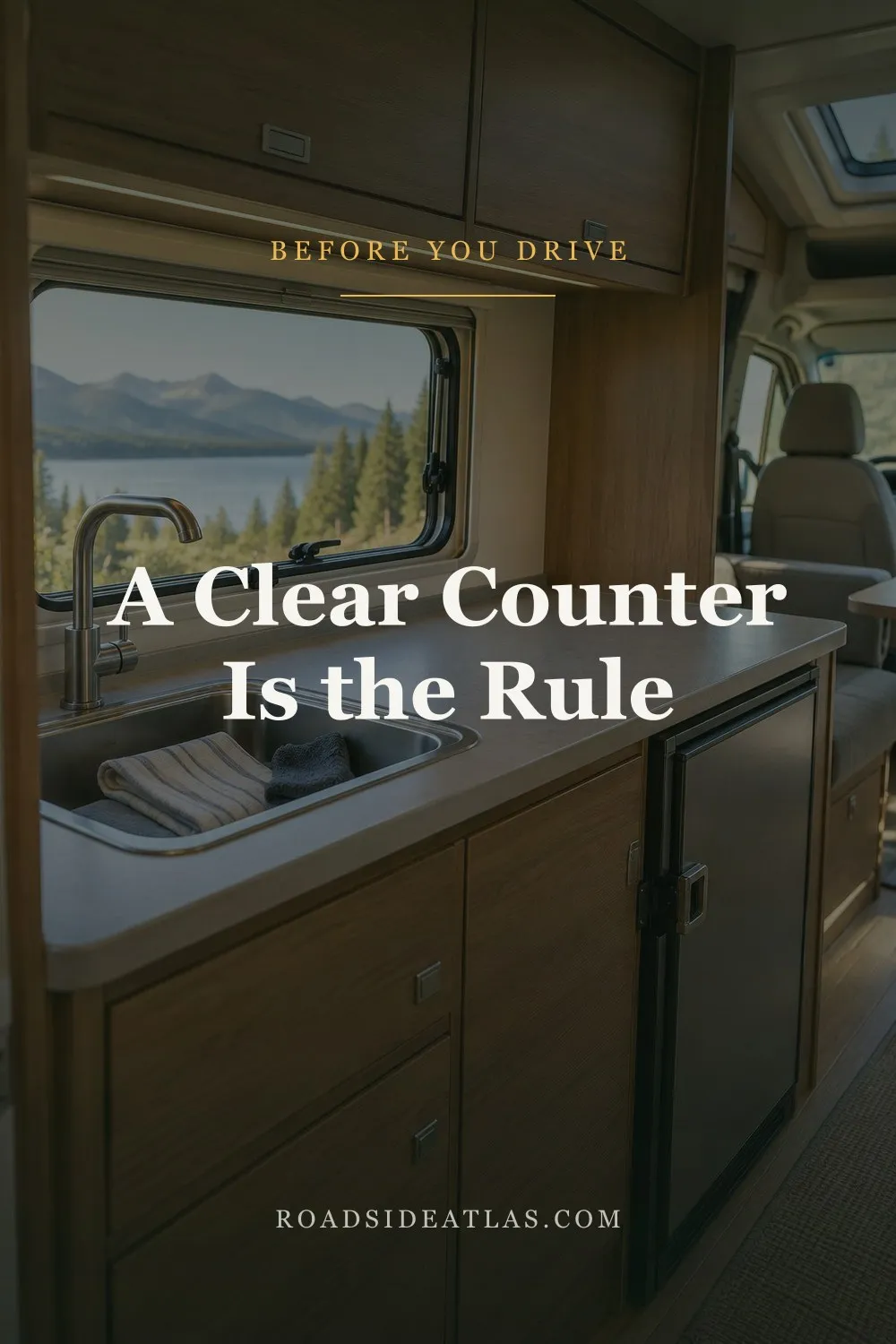
4. Counters and the table. Anything left on a flat surface ends up on the floor. A clear counter is the rule, not a preference. The sink and the shower stall are the usual places to put loose things for the drive, because they have walls and drains, not edges.
5. The microwave. The glass turntable sits loose on its spindle. Take it out and wrap it in a towel, or lay it flat in a drawer with something soft under it.
6. The cab-over bunk. On a Class C it is the obvious storage space and the worst place for anything heavy: it is high, it is at the front, and it is directly above the people in the cab. Pillows, sleeping bags and soft bags only.

7. The slide-out. If the rig has one, anything that sits in its path — a cooler, a bin pushed against the wall — has to be moved before you bring it in, or the slide cannot close. Do it before you start the engine, not after.
The weight nobody adds up
Organization is about weight as much as space, and most renters never see the number that matters.
We looked at the published specification for the Winnebago Minnie Winnie 22M, one of the most common Class C rentals and the rig we used in our water system guide. Winnebago’s 2026 specification, read on 6 October 2026, lists these:
| Published spec | Minnie Winnie 22M |
|---|---|
| Gross vehicle weight rating (GVWR) | 14,500 lb |
| Front axle rating (GAWR) | 5,000 lb |
| Rear axle rating (GAWR) | 9,600 lb |
| Fresh water tank | 40 gal |
| Exterior storage | 44.5 cu ft |
| Sleeps | 5 |
What it does not list is how much you can load. The specification has no unloaded weight and no cargo carrying capacity. That number exists — it is GVWR minus what the rig weighs as built — but it depends on the individual vehicle and its options, so it is printed on a weight label inside the rig, usually inside a cabinet or near the driver’s seat, rather than in the brochure.
Find that label at pickup and photograph it. Everything below is arithmetic on top of it.
Water is the heaviest thing you will pack
Water weighs about 8.34 lb per gallon. A full 40-gallon fresh tank is 334 lb — two adults’ worth, carried before anyone gets in. That is why our water guide says to carry about a third of a tank for the drive and fill up near where you are staying.
The holding tanks count too. Driving to the dump station with a full grey (45 gal) and black (40 gal) tank is 709 lb of water on board.
The two axles have their own limits
Add up the two axle ratings on the 22M: 5,000 + 9,600 = 14,600 lb, a hundred pounds more than the GVWR. That gap is the point. You can be under the total and still overload one axle, simply by putting too much in one place.
On a Class C the rear axle carries most of the weight. Weight placed in a compartment behind the rear axle loads that axle by more than its own weight, because it levers against the front. Heavy cargo belongs low, close to the floor, and between the axles. The rear-most bay is for things that are bulky but light.

The outside bays are smaller than they look
The 22M’s exterior storage is 44.5 cubic feet across all of its compartments. A common 27-gallon storage tote is about 3.6 cubic feet, so by volume that is roughly a dozen totes. In practice it is fewer, because bay doors and shapes rarely line up with a tote. Measure the bay openings before you buy bins, not after.
Where everything goes
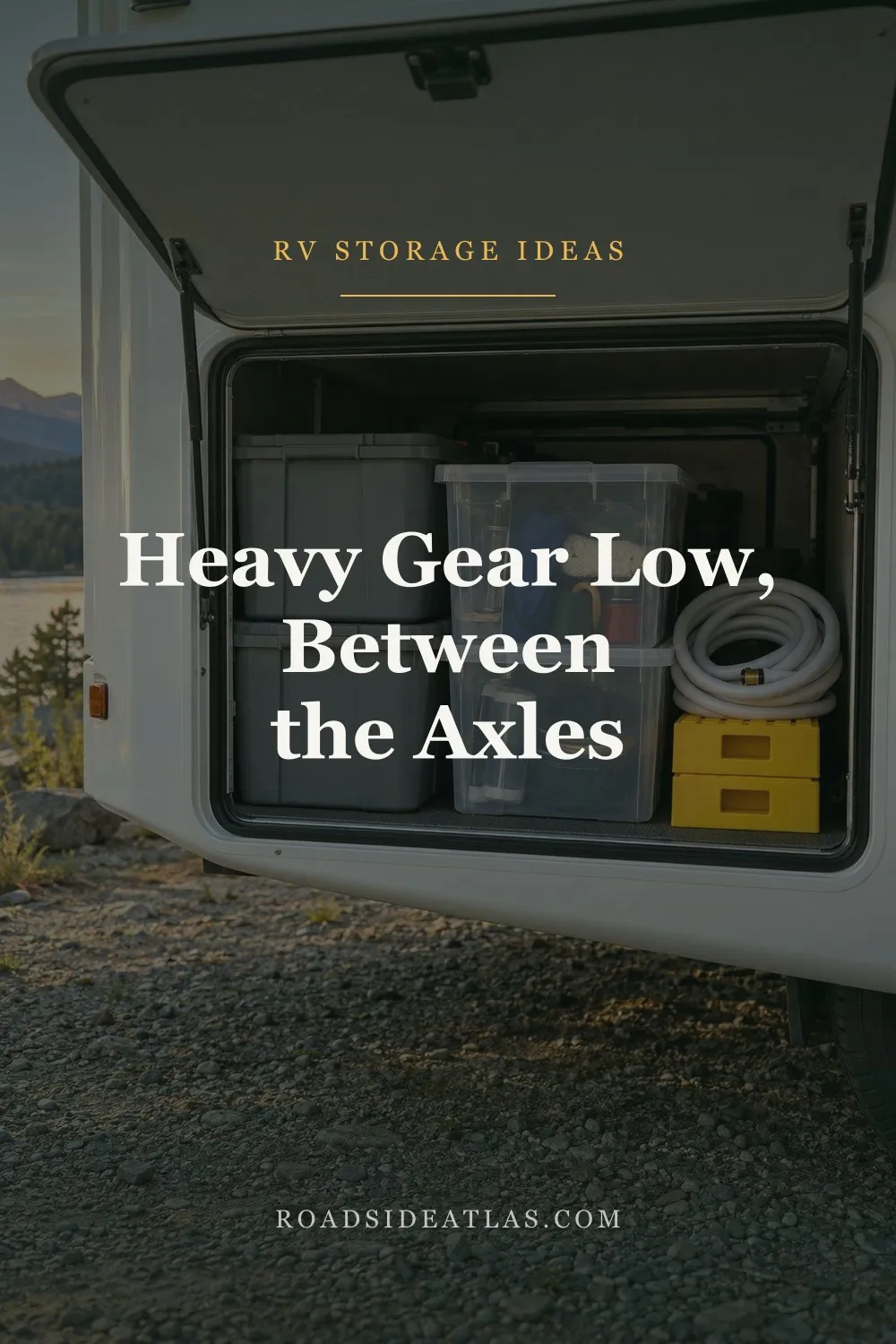
| Zone | What goes there | Why |
|---|---|---|
| Floor-level bays between the axles | Water hose, sewer kit, leveling blocks, tools, canned food | Heaviest items, lowest and most central |
| Rear-most bay | Camp chairs, outdoor rug, empty bins | Bulky but light; weight back here loads the rear axle the most |
| Lower kitchen cabinets | Pots, pans, plates, heavier food | Low and close to where you use them |
| Drawers | Cutlery, utensils, small light items | Keep heavy things out so the latches hold |
| Overhead cabinets | Dry food in bins, paper goods, light clothing | Light, in bins that fill the shelf depth |
| Cab-over bunk | Pillows, sleeping bags, soft bags | High and over the cab: soft and light only |
| Sink and shower | Anything loose, for the drive only | Walls and a drain; nothing falls out |
The rule under the whole table is short: heavy low and in the middle, light high and at the ends. The rest is detail.
For what to bring in the first place, the RV packing list covers the gear. This page is about where it rides.
The walk-through before you pull out
Run this every time you move the rig, not just on day one. It takes three minutes, and it is the difference between arriving to a tidy camper and arriving to a floor covered in oatmeal. If you are renting, do the weight label part at the pickup inspection.
Camper pre-drive walk-through
18 items · 3 categories
Camper pre-drive walk-through — roadsideatlas.com
Run it every time the rig moves. Print one and tape it inside a cabinet door.
Inside, front to back
- Cab-over bunk: soft things only, nothing that can fall forward
- Counters and table clear; loose items in the sink or shower
- Microwave turntable out and wrapped
- Fridge packed tight and the travel latch engaged
- Every drawer and cabinet latched (push each one)
- Overhead cabinets: bins only, nothing heavy
- Shower door and bathroom door latched
- Roof vents closed, TV and antenna stowed
Outside
- Slide-out in, with nothing in its path inside
- Steps retracted, awning stowed and locked
- Every bay door closed and locked
- Hookups disconnected: water, sewer, power
- Leveling blocks picked up and stowed
Weight
- Cargo carrying capacity from the label inside the rig (lb)
- Fresh tank: how full do you need it for this leg?
- Grey and black tanks emptied before a long drive if you can
- Heaviest gear in the low bays between the axles
- Rear-most bay: light, bulky things only
If you take one thing away: organize for the drive, then for the campsite. A camper that survives the road is already organized when you park.