The RV Fridge: Propane, 12 V, and the Cost of a Night

DisclosureThis page contains affiliate links. If you buy through them, we may earn a commission at no extra cost to you.
Everything else in an RV gets switched off at night. The lights go off, the laptop closes, the water pump sits idle. The fridge keeps going, all night and all the next day.
So on a site with no hookup, the fridge decides how long the house battery lasts. And how much it takes depends almost entirely on which kind of fridge your rental has, and which mode it is in — something most renters never check.
The three kinds of RV fridge
| Kind | Runs on | Where you find it |
|---|---|---|
| 2-way absorption | Propane, or 120 V from a hookup or generator | Most Class C and Class A rentals |
| 3-way absorption | Propane, 120 V, or 12 V from the battery | Some trailers and older rigs |
| 12 V compressor | The house battery, all the time | Most new camper vans |
Two common rentals show the split. Winnebago’s 2026 specifications list the Minnie Winnie 22M (Class C) with a 6.3 cu ft 2-way fridge, and the Travato 59KL (camper van) with a 4.3 cu ft 12-volt compressor fridge. Same job, two different machines.
An absorption fridge makes cold with heat — a small propane flame or an electric heater element. A compressor fridge works like the one in your kitchen. That difference is the whole story of the battery.
What each one takes in a day off grid
The numbers below come from the manufacturers, not from forum estimates.
- Dometic publishes the comparison directly on its NRX 90V compressor fridge page: 0.4 kWh in 24 hours, against 2.5 kWh for an absorption fridge of the same size. That is 400 Wh against 2,500 Wh.
- Dometic’s operating manual for its Americana absorption fridges lists the electric heater as 175 W, at 120 V and, on 3-way models, at 12 V.
- The house battery: a standard 100 Ah lead-acid battery gives you about 600 Wh you can use, as worked out in our RV power guide.
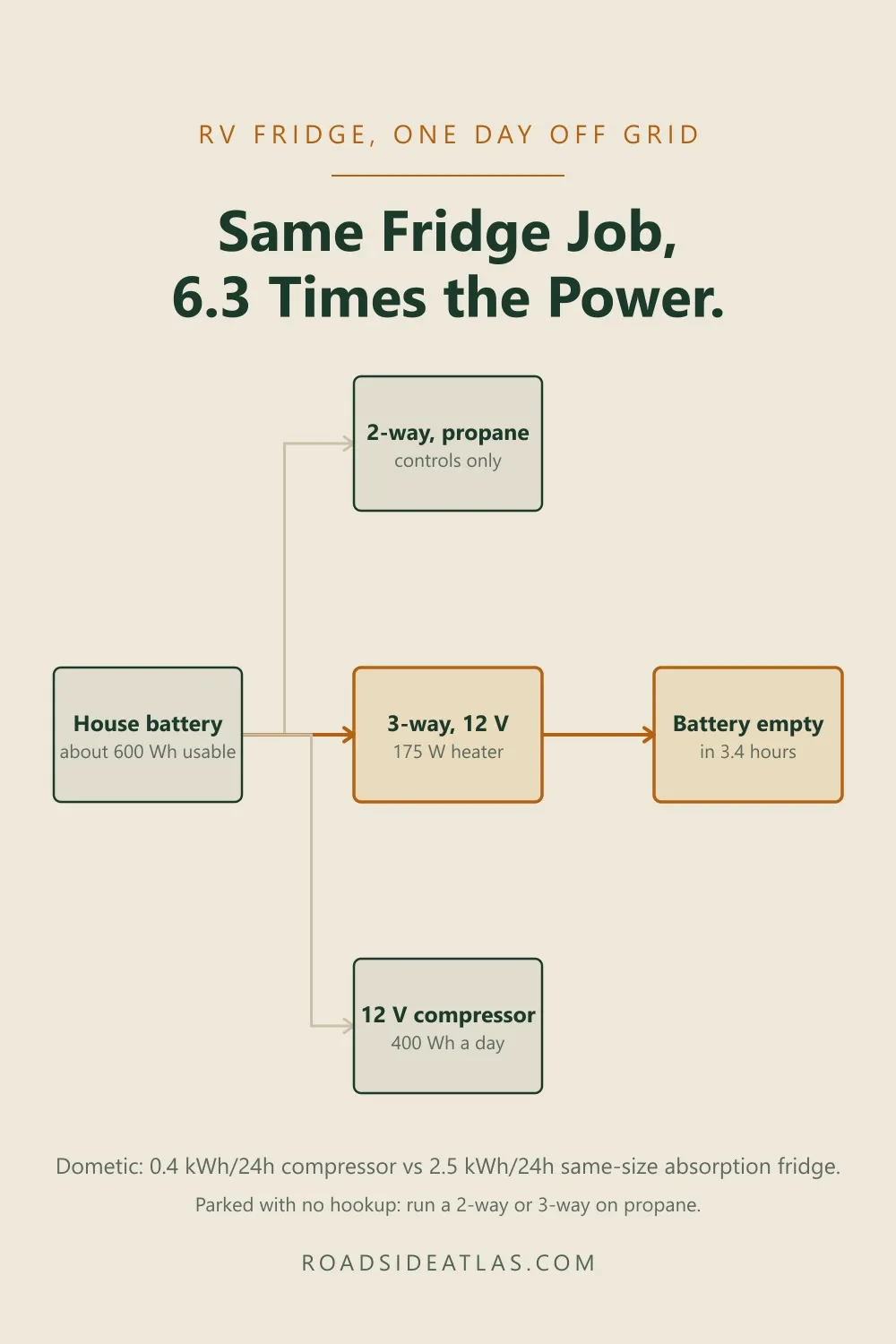
| Fridge and mode | From the battery in 24 hours | Against a 600 Wh battery |
|---|---|---|
| 2-way or 3-way on propane | The controls only | Close to nothing |
| 12 V compressor | 400 Wh | 67% |
| 3-way on 12 V | Up to 2,500 Wh | 4.2 times the battery |
One honest limit: Dometic’s comparison is for a 90-liter fridge, about 3.2 cu ft. A rental’s 4.3 or 6.3 cu ft fridge is bigger and will use more. The ratio is the useful part — an absorption fridge on electricity uses 6.3 times what a compressor fridge does for the same box of cold.
The 2-way fridge on propane: the battery barely notices
When a 2-way fridge runs on propane, the flame does the cooling. The battery only powers the control board. Dometic’s manual says the fridge needs a continuous 12 V supply for its electronics, and that the controls still draw “a few milliamps” even when it is switched off.
That is why a Class C on a dry site can keep food cold for days without touching the generator. The cost moves to the propane tank.
How much propane? We cannot give you a number we trust. Dometic and Norcold do not print the gas input in the owner’s manuals we checked, and the absorption product pages no longer show it. The rating is printed on the information label on the fridge itself, in BTU per hour. If you want to plan your propane, that label is the source — not a figure from a forum.
The 3-way fridge on 12 V: the battery is gone before bedtime
A 3-way fridge can also cool from the 12 V battery, through the same kind of heater element: 175 W, which is 14.6 A at 12 V.
Run that heater nonstop and it would use 4,200 Wh a day. It cycles, so it does not quite: Dometic’s 2.5 kWh figure works out to an average of 104.2 W, which implies the heater is on about 60% of the time. Either way, against a 600 Wh battery:
- With the heater on, the battery is empty in 3.4 hours.
- At the 24-hour average, it lasts 5.8 hours.
Dometic’s own manual says it plainly: when nothing is charging the house battery, switch to AUTO or GAS, because running the fridge on 12 V “will quickly drain the battery.” The 12 V mode is for driving, when the engine is charging. Park, and switch it to propane.
The 12 V compressor fridge: efficient, and nowhere to hide
The compressor fridge is the efficient one. 400 Wh a day is an average of 16.7 W. At that rate, the 600 Wh battery would carry the fridge alone for 36 hours.
But it cannot switch to propane. Everything it uses comes out of the battery, so it takes 67% of a lead-acid battery’s usable charge in a day and leaves 200 Wh for the lights, the water pump, the furnace fan and every phone in the van. In hot weather it runs longer; our power guide puts a 12 V compressor fridge at 250–450 Wh a day in mild weather and 450–700 Wh in heat.
This is why so many camper vans carry solar panels, and why van renters plan a drive most days. The compressor fridge is the reason the battery matters in a van in a way it does not in a Class C. If the van does not have enough to cover a second day, a portable power station of 1–2 kWh carries the fridge through it — BLUETTI and Jackery both make units in that range, and our generator vs battery comparison runs the cost of each over a season.
So which mode, when?
| Where you are | 2-way | 3-way | 12 V compressor |
|---|---|---|---|
| Hookup with 120 V | AUTO (picks 120 V) | AUTO | Runs from the converter |
| Driving | Propane, if your rental allows it | 12 V | Battery, charging from the engine |
| Parked, no hookup | Propane | Propane | Battery, then solar or a station |
Rules on running propane while driving differ between rental companies and fuel stations, so read your rental’s rules for that row. The last row is the one that costs people their battery: a 3-way left on 12 V after the engine is off.
Check the fridge at pickup
Most of this can be answered in two minutes at the pickup, with the staff still there.
RV fridge check at pickup
12 items · 3 categories
RV fridge check at pickup — roadsideatlas.com
Ask before you drive away. Write the answers down.
Which fridge
- Kind: 2-way, 3-way, or 12 V compressor?
- Capacity (cu ft) from the spec sheet
- Where is the mode switch or the AUTO / GAS button?
- Gas rating (BTU/h) on the label inside the fridge
Propane
- Is the tank full? How do you read the gauge?
- Should the propane be off while driving?
- Light the fridge on propane once, before you leave
- Where is the propane shutoff valve?
Battery
- House battery type: lead-acid or lithium?
- Rated amp-hours (lead-acid: half is usable)
- Is there solar? How many watts?
- Parked with no hookup: switch a 3-way off 12 V

If you take one thing away: the fridge is cheap on propane and expensive on the battery. Find out which kind you have before the first night, and on a dry site, give it the flame.