Full, Partial, Dry: What a Campsite Hookup Actually Gets You

DisclosureThis page contains affiliate links. If you buy through them, we may earn a commission at no extra cost to you.
Campsite listings describe hookups in words — “full”, “partial”, “electric”, “primitive” — and price them in dollars. What they never do is tell you what the difference between two tiers is actually paying for.
You can work it out, though, because some campgrounds sell more than one tier side by side. Compare two sites in the same park, and the price gap is the price of the thing that changed. We found two parks that make that comparison clean, and the two answers are very different.
Electricity is the expensive step. The sewer is the cheap one.

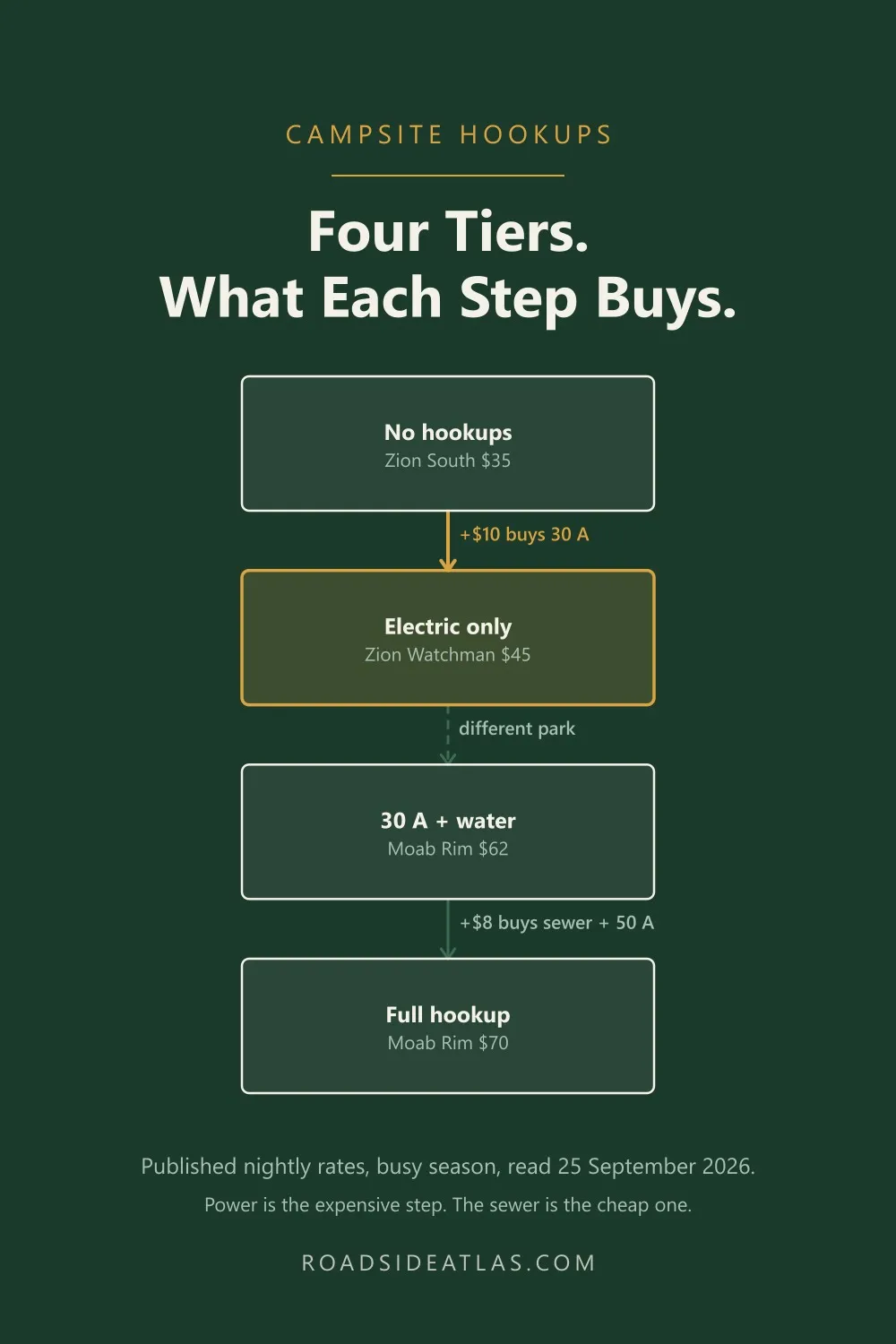
The four tiers, in one picture
| Tier | What is at the site | Example | Nightly |
|---|---|---|---|
| No hookups | Nothing. Your battery, your tanks | Zion, South Campground | $35 |
| Electric only | A power pedestal, usually 30 A | Zion, Watchman electric site | $45 |
| Partial | Power and a water spigot | Moab Rim Campark, 30 A + water | $62 busy / $42 winter |
| Full | Power, water and a sewer connection | Moab Rim Campark, full hookup | $70 busy / $44 winter |
Prices are the published nightly rates, read on 25 September 2026: Zion’s from the National Park Service fee schedule (in effect since July 2024), Moab Rim Campark’s from its own rate page, where they are quoted plus tax for two people. The two parks are in different towns, so do not read the table top to bottom as one staircase. Read it in pairs.
Pair one: what $10 of electricity buys at Zion
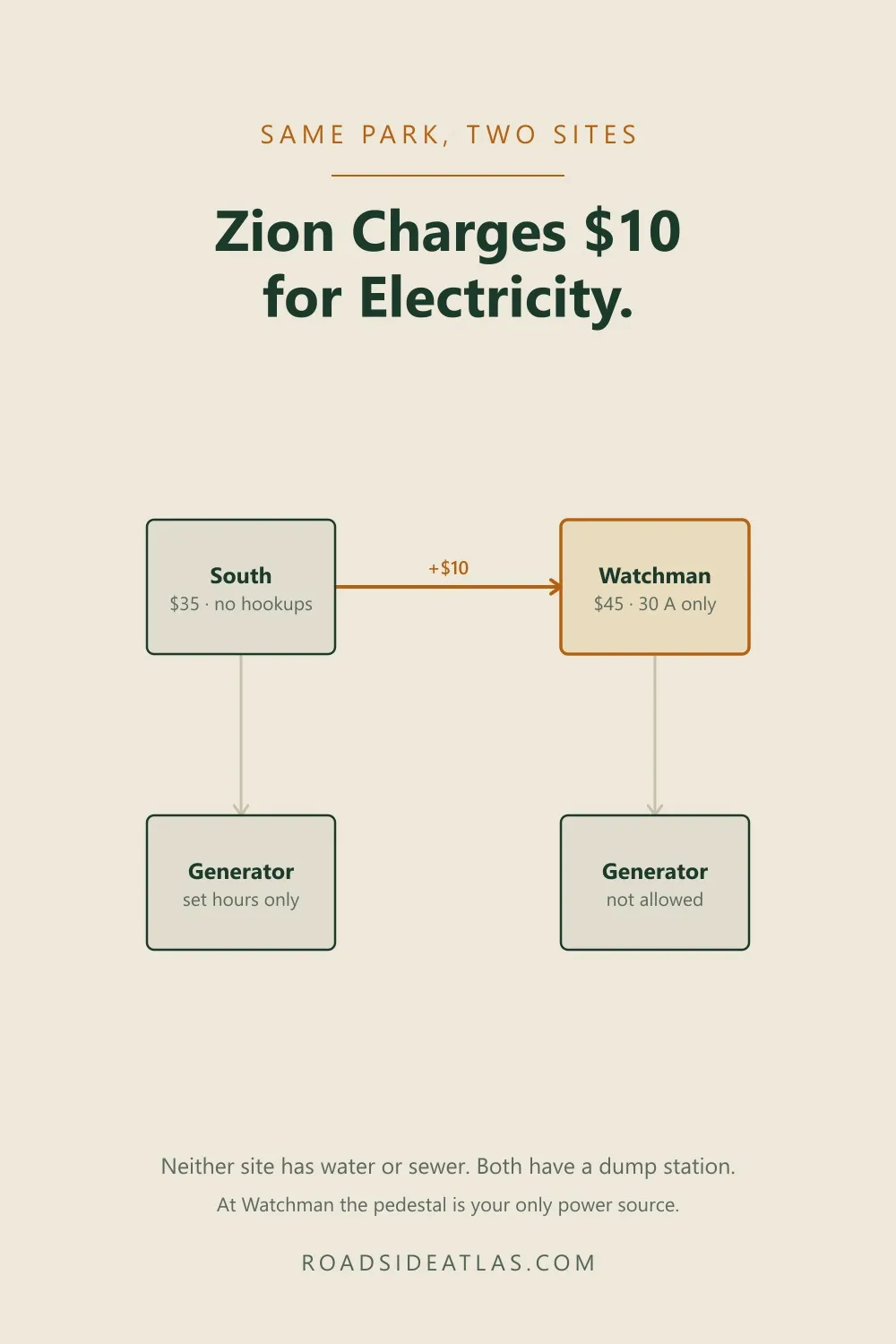
Zion runs two campgrounds a short walk apart. South Campground has no hookups of any kind at $35. Watchman’s electric sites are $45. Neither has a water spigot or a sewer connection at the site; both have a dump station. So the $10 is the price of one thing: a 30 amp pedestal.
The detail that makes it a real decision is the generator rule. According to the campground listings on recreation.gov, South allows generators during set hours. Watchman does not allow them at all. At Watchman, the pedestal is not a convenience. It is your only power source.
What does that pedestal replace? In our daily power budget, two people with no hookups use about 1,015 Wh a day — fridge, furnace blower, fan, lights, phones, a laptop. A standard lead-acid house battery gives about 600 Wh before you start damaging it.
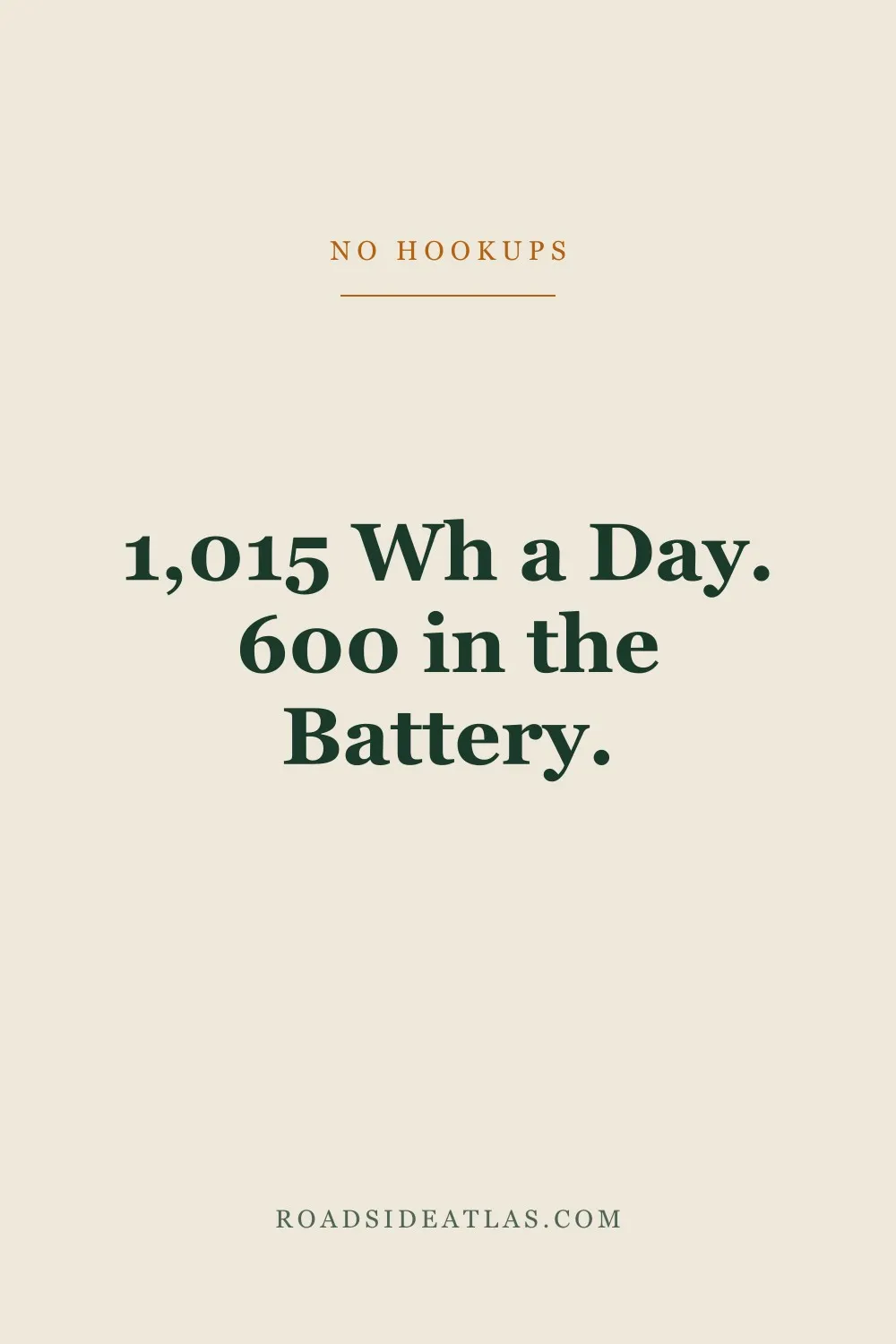
So on a no-hookup site, something has to cover the gap every day: the rental’s generator, solar, or a portable power station. If you already carry one sized for the job — our generator vs battery comparison runs the numbers, and BLUETTI makes units in that range — then $10 a night buys you very little. If you do not, the electric site is the cheapest way to stop worrying about it.
One more thing $10 does not buy: water. At both campgrounds you arrive with a full fresh tank and leave via the dump station.
Pair two: what $8 of sewer buys in Moab
Moab Rim Campark sells two RV site types on the same rate card:
| Site | Hookups | Winter | Busy season |
|---|---|---|---|
| 30A Power & Water Only | 30 A, water | $42 | $62 |
| Full Hookup Pull-thru | 30 A and 50 A, water, sewer, cable TV, Wi-Fi | $44 | $70 |
| Difference | sewer, 50 A, cable | $2 | $8 |
Eight dollars a night in busy season, two in winter. Over a week that is $56 at the most.
What you are actually paying for is not the sewer hose. It is not having to move. On a partial site, the water spigot never runs out, so the fresh tank stops being the thing that ends your stay. The grey tank takes over.
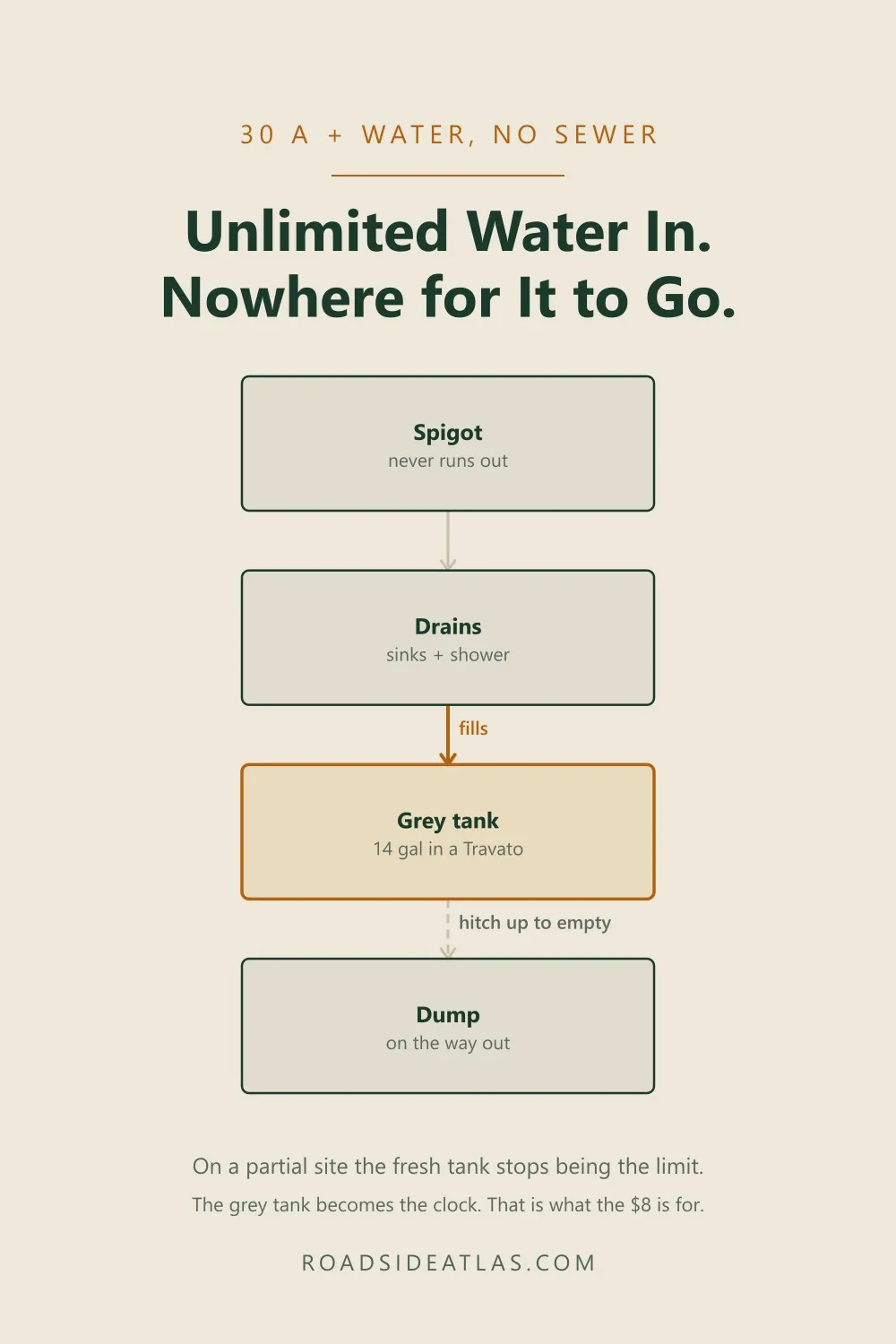
In our RV water system guide we pulled Winnebago’s published tank sizes. The Travato 59G van has a 14 gal grey tank — smaller than its 18 gallon fresh tank. The Minnie Winnie 22M Class C has 45 gal. With a spigot hooked up and showers running, the van’s grey tank is the limit on how long you can stay put. When it is full, you pack up, unhook the power, drive to the dump, and come back.
So the rule of thumb:
- One or two nights, any rig: partial is fine. Dump on the way out.
- Three or more nights in a small-tank rig: the $8 is the cheapest thing on the trip. Pay it.
- Winter: at $2, there is nothing to decide.
What the “50 A” in full hookup actually means
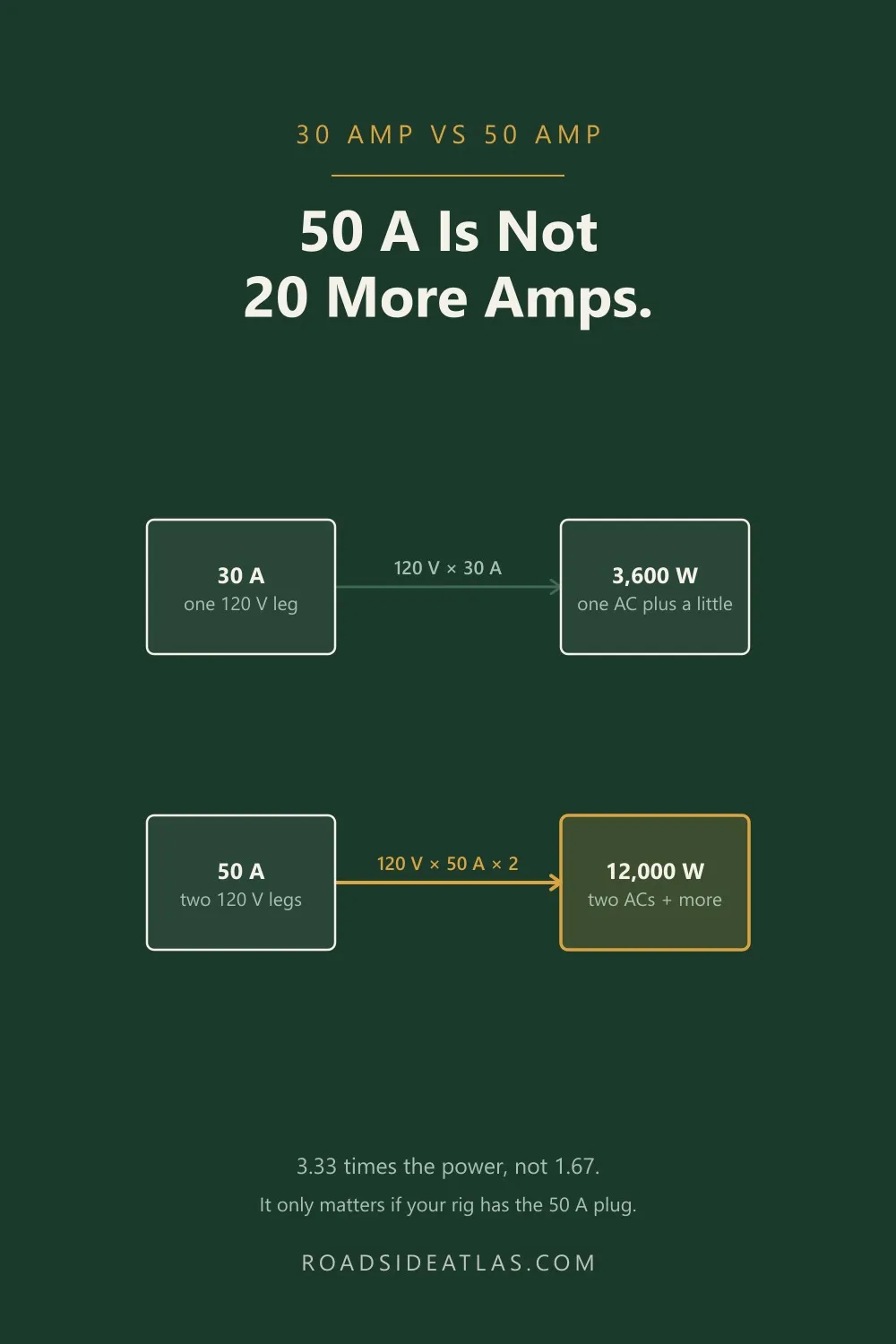
Full-hookup sites often come with 50 A service, and it sounds like a small upgrade. It is not.
- 30 A is a single 120 V circuit: 120 × 30 = 3,600 W. Enough for one rooftop air conditioner (1,300–1,800 W) with some room for the fridge and lights, and not much else at the same time.
- 50 A is two separate 120 V circuits of 50 A each: 120 × 50 × 2 = 12,000 W. That is 3.33 times the power, not the 1.67 the numbers suggest.
It only matters if your rig has a 50 A plug — typically the larger motorhomes with two air conditioners. A van or a small Class C has a 30 A plug, and plugs into a 50 A pedestal through an adapter while still drawing no more than 30 A. For most rentals, the 50 A in “full hookup” is a feature you cannot use.

Choosing the tier

Work it out from your rig, not from the listing:
- Can you cover about a day’s power without a pedestal? If yes, no-hookup sites are open to you, and they are usually the ones inside the parks. If no, book electric — and check whether the campground allows generators before you plan on the rental’s.
- How big is your grey tank, and how many nights are you staying? Small tank and three nights or more: full hookup. Otherwise partial, and dump on the way out.
- Does your rig have a 50 A plug? If not, do not pay extra for 50 A.
When you book through a marketplace like Campspot, check the type of the specific site you are booking, not the park’s list of amenities. A park that “has full hookups” may also sell water-and-power sites a few dollars cheaper, which on a two-night stay is the better booking.
Campsite hookup checklist
16 items · 3 categories
Campsite hookup checklist — roadsideatlas.com
Fill in the rig column from the rental listing or the manufacturer's spec sheet before you book anything.
Your rig
- Plug: 30 A or 50 A?
- House battery: lead-acid or lithium, and its amp-hours
- Generator included? How many hours?
- Fresh tank (gal)
- Grey tank (gal)
- Black tank (gal)
The site
- Tier of this specific site, not the park
- Amps at the pedestal
- Water at the site?
- Sewer at the site?
- Generator rules and hours
- Dump station on site, and any fee for it
The decision
- Can you cover ~1,015 Wh a day without a pedestal? If not, book electric
- Grey tank vs nights: small tank + 3 nights or more, book full
- 30 A rig: skip paying extra for 50 A
- Pack a 30 A to 50 A adapter anyway
If you take one thing away: the pedestal is worth paying for when you have no other power. The sewer is worth paying for when you have a small grey tank and a long stay. Everything above that is a nicer word on the listing.